
€2,652.47 in 17 Days: How a Sports Publisher Beat a Fixed Daily Deal
A sports publisher in Vietnam took a gamble. They left Adcash for a competitor’s fixed daily rate of €200. Then they came back. Within 17 days, on Adcash’s variable RPM model, they were clearing over €250 a day. The timing helped, as the FIFA World Cup 2026 was driving sports traffic worldwide. Weekly earnings peaked at €1,283, and RPM climbed from €4.34 to €7.53.
This case study breaks down the fixed vs variable ad revenue question for traffic that spikes around events. It shows where World Cup ad revenue actually comes from. And it makes a strong case for not overlooking Southeast Asian sports traffic, which earns steadily long after the tournament ends.
A guaranteed daily payout sounds like the safe choice. You know exactly what lands in your account every day – no surprises. But with no risk comes no reward. There’s got to be the small question in the back of your mind – could I be doing better?
Our publisher runs a sports site out of Vietnam. For a while, they left Adcash for a competitor offering a fixed daily rate of €200. It felt stable. Then they came back. Within their first 17 days, they were clearing well over €250 a day on a variable model. Same traffic, same site, way more money.
Why Fixed Daily Deals Cap Publisher Earnings
The fixed vs variable ad revenue question comes down to one thing: demand fluctuations. A fixed daily rate is a trade. You take predictability; in exchange, you give up the upside on your best days. For some publishers, that is a fair deal. If your traffic is steady and your volume is easy to forecast, a guaranteed daily figure can be exactly what you want.
Sports traffic is not that kind of traffic. It spikes hard around fixtures and tournaments, then settles. When there’s hype and excitement, profits roll in. A fixed deal flattens those spikes into one number, which means the days that should pay the most pay the same as the quiet ones. You bring the surge, but the rate does not move with it.
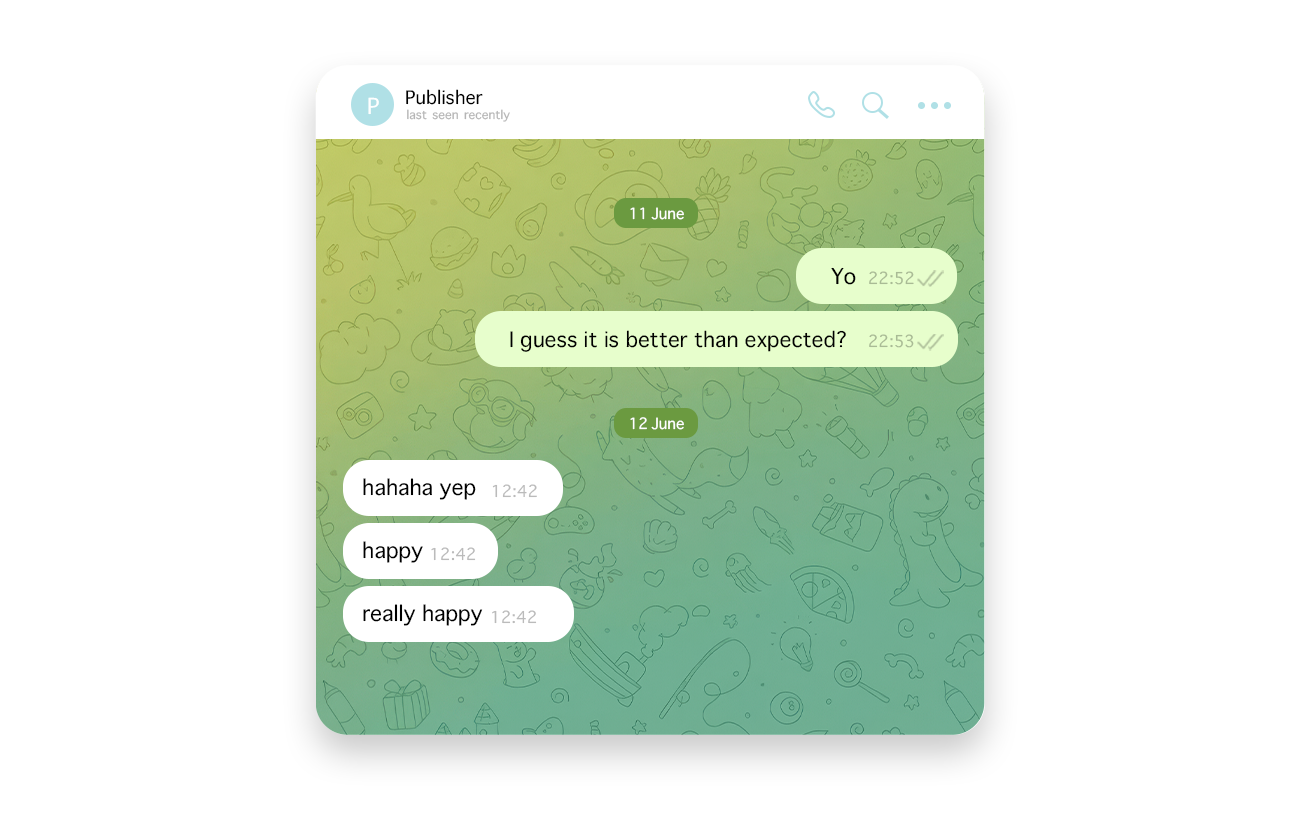
Our publisher clearly believed he could do better. And he was right. Oh, and very, very happy.
Fixed vs Variable Ad Revenue: Why Variable Pays More
A variable RPM model pays more because your rate scales with real-time advertiser competition for your inventory. They came back to Adcash for this exact model, where the rate moves with demand. But a model is only half of it. A rate that climbs with demand only works if there is demand to climb toward. I.e., advertisers actively bidding for your inventory.
That is the part a network either has, or it doesn’t. Good news for our publisher – Adcash is firmly in the “has” category. With 200+ supply partners and global advertiser demand spanning 195 countries, there is real competition for your inventory. When advertisers compete harder, you earn more. The better the day, the better the rate – the complete opposite of a fixed deal.
The timing turned out to be ideal, because the good days were about to arrive all at once. Enter the biggest sporting festival in the world: the FIFA World Cup 2026.
The Results
Seventeen days back with Adcash, with the World Cup driving sports traffic worldwide. Here is how the three weeks looked. Pay close attention to the RPM column – that is where the variable model earns its keep.

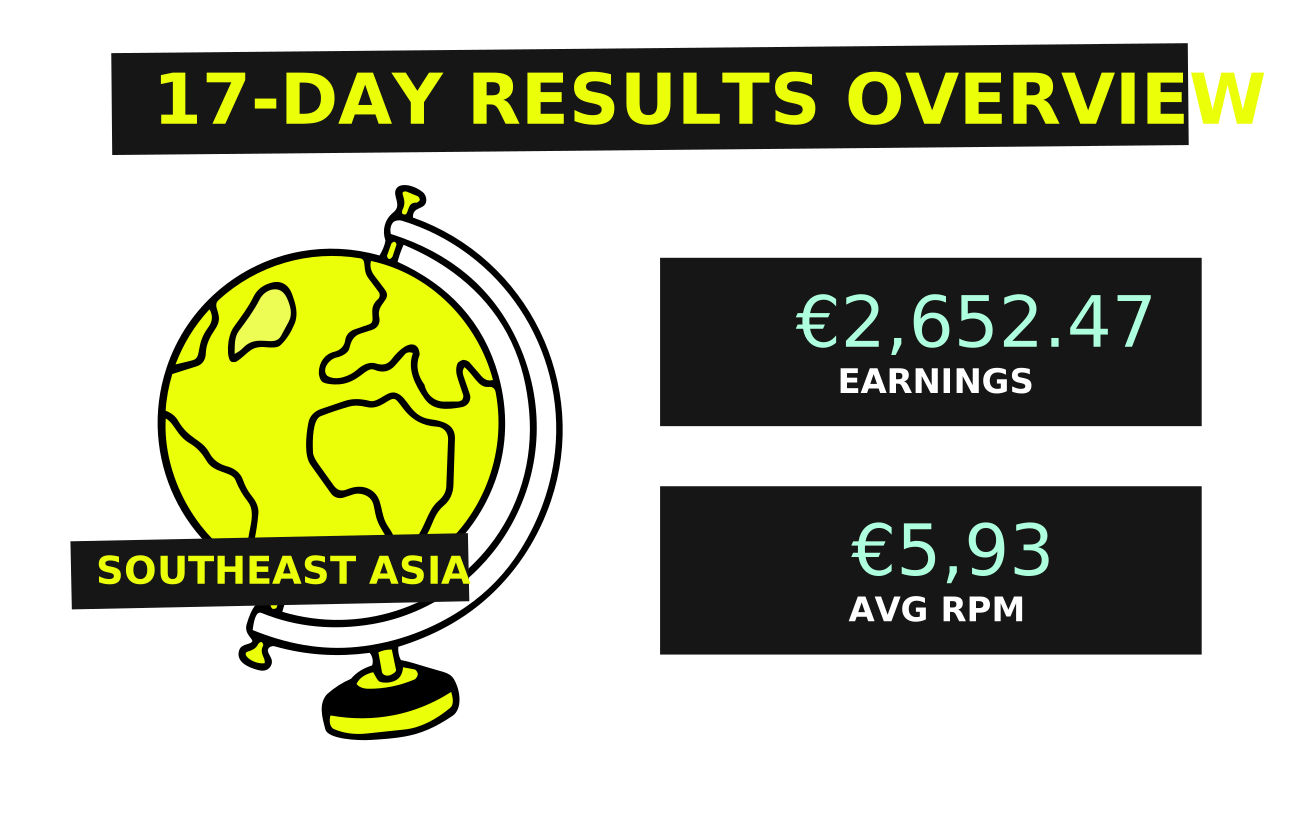
Across the three weeks, that is €2,652.47 in 17 days back on the platform. Two full weeks and a partial one, beating the old €200 daily deal comfortably.
The number that matters is the RPM column. It climbs every week, from €4.34 to €5.92 to €7.53. That is demand rising and the variable model passing it straight through to the publisher.
A fixed €200 a day would have paid €200 a day through all of it – including the week that broke €1,283.
That climb does not happen on thin demand. The rate rose because there were enough advertisers competing for World Cup inventory to push it there, week after week.
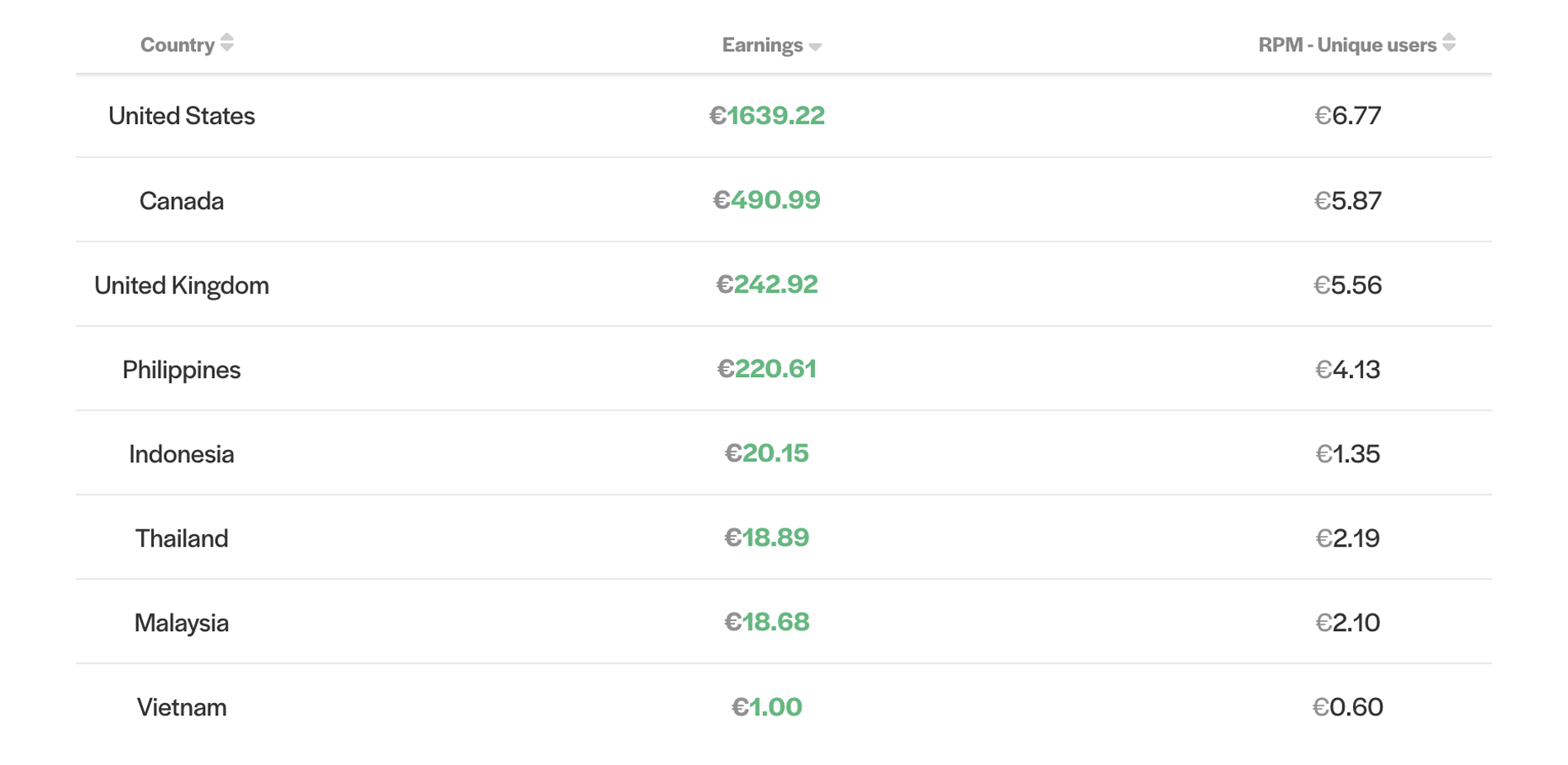
Here is where that money came from, by country:
Why World Cup Traffic Comes From Tier 1 Countries
As the higher-ups in FIFA want you to remember – Football is the World’s Game. As cheesy as that sounds, the thing with sport… it kind of is. Sport doesn’t work within GEOs. Get a big enough tournament, match, or fight and the world is going to want to watch.
Just look at the traffic if you don’t believe me. A Vietnamese sports site with massive traffic from the US, Canada, and the UK. The World Cup and its timezone haven’t been kind to Asia. Match times perfect for the Americas are awkward for viewers in Southeast Asian time zones.
There are going to be diehard fans in Asia, as the data from the Philippines shows. However, a lot of the audience watching the tournament, reading about it, and following results in real time sits in North America and Europe. That demand is where the high RPM lives. The US alone returned €6.77 per thousand users, and it carried the blended rate for the whole site.
A publisher based in Vietnam captured Tier 1 sports money during a global event, because the audience for that event was global. That is how programmatic advertising works – Adcash’s platform matches advertiser demand to the audience visiting your site, not to where your site is based. On a fixed deal, none of that geographic upside would have reached them. The variable model let the traffic earn what it was actually worth, wherever it came from.
Southeast Asia Traffic: Steady Earnings Beyond the World Cup
Southeast Asian sports traffic delivers consistent, year-round earnings – with or without a global tournament. The World Cup spike will sadly fade. Tournaments end, and some of that Tier 1 traffic goes with them. What does not fade is the home audience.
Look at the lower half of the GEO table again. The Southeast Asian markets earn at a lower rate than Tier 1, and that is normal for the region. But the Philippines is at €4.13, Thailand at €2.19, Indonesia at €1.35. These are solid rates for SEA sports traffic, and that traffic shows up every day, event or no event. It is the base the site is built on. The World Cup is the spike on top of it.
The keyword here is consistency. You don’t get those numbers without it. Home traffic earns steadily and reliably. When a global event sends international demand your way, a variable model lets you capture that on top, instead of watching it disappear into a fixed rate. You get the floor and the upside. No need to trade one away for the other.
Conclusion
Three takeaways from this case study:
- Variable beats fixed for event-driven traffic. A fixed daily deal caps the days that should pay you most. A variable model pays you what your traffic is worth on any given day, which is exactly what you want when your traffic is built on events that spike.
- Know where your rate comes from. The geo mix tells you which audiences carry your earnings. In this case, Tier 1 traffic from markets like the US, Canada, and the UK lifted the blended RPM for the whole site.
- Build on a steady base. The peaks fade, but a steady home audience keeps earning after the tournament ends. Long-term monetization comes from that base, with global events adding upside on top.
This publisher already knew their audience. What changed was getting paid full value on the best days. That only happens with the advertiser demand to back it up. If your traffic spikes around events, a flat rate is costing you on every peak. Look at the gap between €200 and €1,283. That is the size of it.
Ready to see what your traffic is actually worth? Start monetizing with Adcash and let demand work in your favour.
Share
Learn more
Explore our resources and discover how to cultivate wisdom in an information-saturated world.



FAQ
What is an advertising network?
An ad network is like a matchmaker for digital advertising. It connects advertisers (that’s you) with websites (aka publishers) that want to sell ad space. Instead of negotiating with individual sites, you use an ad platform like Adcash to place your ads where they’ll hit the right audience – based on their demographics, interests, or online behavior. More reach, less hassle.
What types of ad formats are there?
There are five main types of ad formats.
Pop-up ads – These appear in a new window or overlay to grab attention and increase engagement.
Pop-under ads – Similar to pop-ups, but they load discreetly in the background, ensuring a non-intrusive user experience.
Interstitial ads – Full-screen ads that appear during content transitions (like between webpage loads or app screens) for maximum visibility.
In-page push ads – These look like traditional push notifications but appear directly on the webpage without requiring user opt-in.
Banner ads – Classic display ads embedded within the webpage, featuring images, text, or animations to drive clicks.
How Can Publishers Balance Revenue and User Experience?
Maximizing earnings shouldn’t mean annoying your visitors. The key? Smart ad placement and quality formats.
Use pop-under ads instead of intrusive pop-ups to keep the user journey smooth.
Limit interstitial ads to natural breakpoints in content flow.
Optimize push ads so they feel native rather than disruptive.
Work with a trusted ad network for publishers (like Adcash) that provides real-time optimization and non-intrusive ad delivery.
With the right balance, you can monetize your website without driving users away.
How do I advertise online?
Pick a solid advertising platform that connects you with top publishers (hint: Adcash). Whether you want pop-up ads, display banners, native ads, or video ads, we make it simple. Set your budget, target the right audience, and launch. Our adserver and programmatic advertising platform handle the heavy lifting – real-time analytics, smart ad optimization, and laser-focused targeting to maximize your ROI.