
File Sharing Traffic Prints Money Everywhere
It all started with a pattern. The publisher had been working in digital for a while, mostly on the operational side. The kind of role where you see how things actually get used. And one thing kept showing up daily: File-sharing.
In emails, chats, and internal tools. Across teams, countries, and industries. Different platforms, same behaviour. People rely on file sharing constantly.
So they built something proven. A simple file-sharing platform focused on doing the basics well. The strategy was straightforward. Don’t reinvent the product. Compete on usability, speed, and accessibility. Make it work globally from day one.
File Sharing
File sharing is a huge part of our lives now. From students sharing coursework to teams sending comms, we rely on it daily. Unlike most verticals, it doesn’t depend on a single audience or region. The demand is global by default. That’s what makes it powerful.
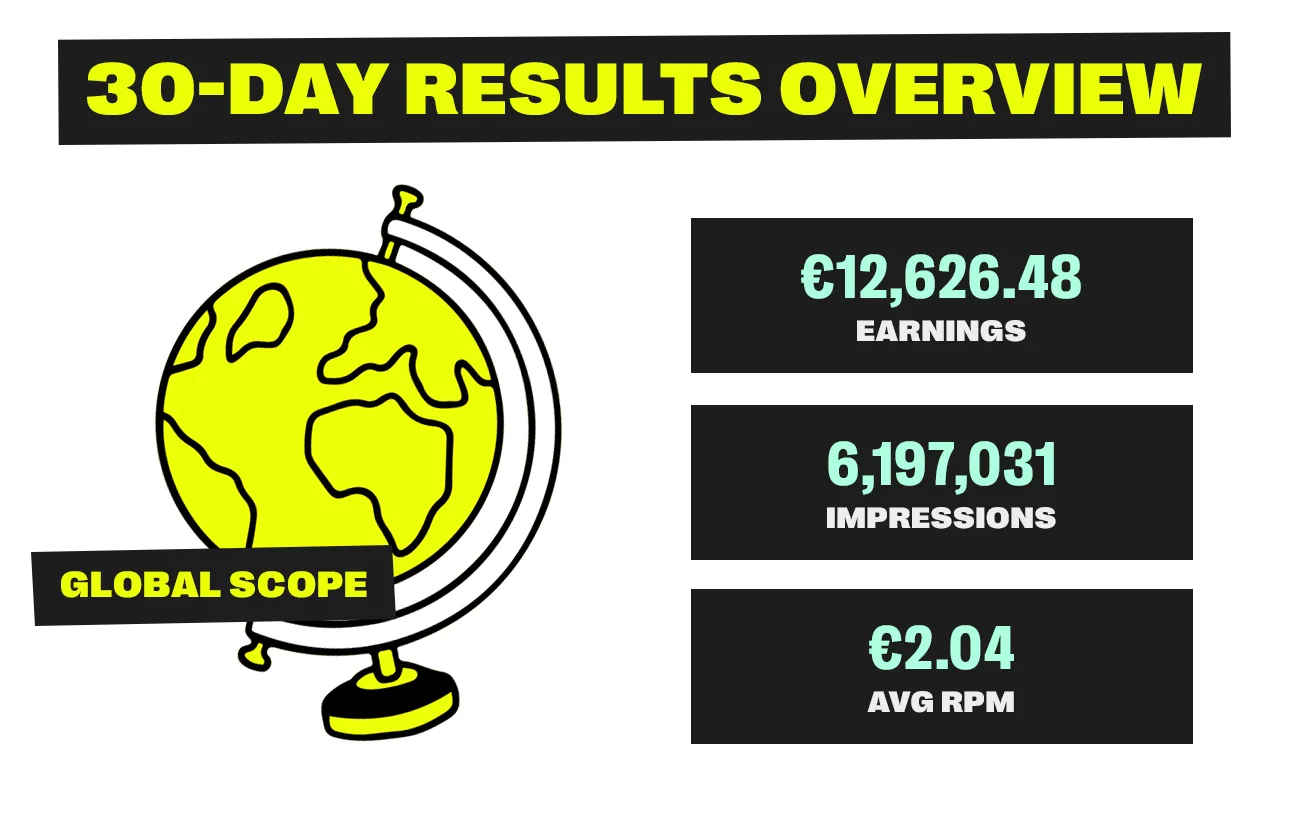
One publisher built around that demand and generated €12,626.48 in a single month, without traffic tricks or heavy optimisation. When your product is needed everywhere, your traffic comes from everywhere.
Why File Sharing Traffic Works
Most publishers deal with trade-offs. You either get scale, or you get high-value users. Rarely both at the same time. File sharing sits in the middle. Because the use case is universal, it attracts users from everywhere, including Tier 1 markets.
No need to optimise for them. You’re not filtering traffic or reshaping it. You’re capturing demand that already exists across regions. That’s the difference. This isn’t carefully curated traffic. It’s built-in demand converting at scale.
The Numbers
In January 2026 alone, the results looked like this:
- 6,197,031 impressions
- €2.04 RPM
- €12,626.48 in earnings

Across 6.2 million impressions, €2.04 RPM is a really strong baseline. It becomes consistent, predictable revenue. That’s the key. This isn’t driven by one high-RPM market or a short-term spike. It’s a blended result from multiple regions contributing at the same time.
Weekly Performance
The growth pattern is straightforward. Performance ramps quickly as traffic builds, then settles into a stable range. There’s no dramatic peak followed by a drop-off, which is common with more aggressive setups.
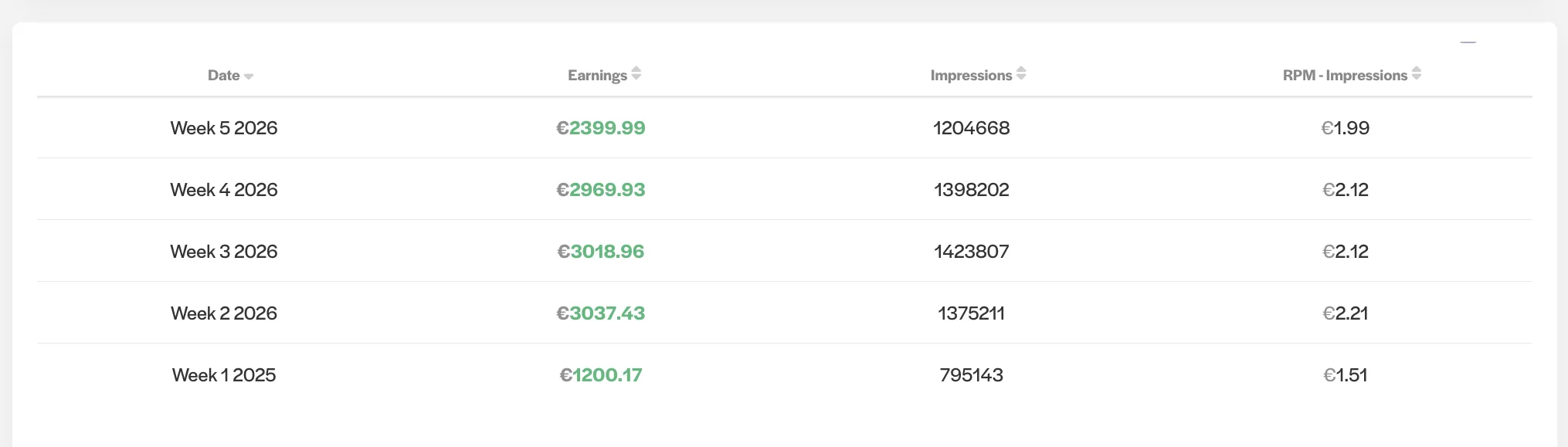
Instead, revenue holds. That’s what makes it scalable. You’re not relying on volatility to drive results. You’re building something that performs week after week.
The Geo Mix
Initially targeting Asian traffic like Japan, Thailand, and India, the publisher soon realised targeting Tier 1 traffic was just, if not more valuable.
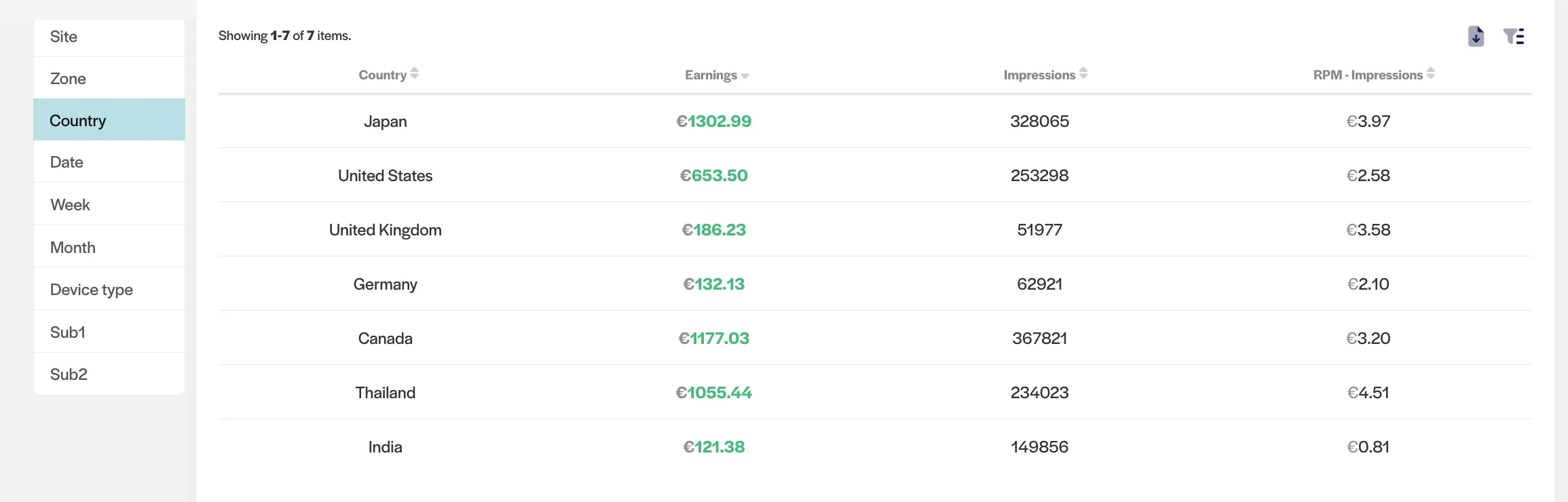
With a vertical like file-sharing, you don’t need to rely on one strong market to make monetizing work. You’re benefiting from all of them, as they benefit from you.
Why It Converts
File-sharing users don’t browse. They follow a process. They arrive to complete a task, and that forces them through a set flow.
Landing page. File page. Download action.
These aren’t optional steps. They’re part of the experience. That matters for monetization.
Because instead of hoping users scroll far enough to see ads, you know exactly where their attention will be, and when. It’s primetime for so many different ad formats.
A perfectly placed display ad near the download button. An interstitial ad between the “upload” and “send” screen. A pop-under waiting for them when they’ve finished their activity.
And it’s all repeatable. They stay long enough to complete the action. They pass through the same key pages. And they come back when they need it again.
That creates something most publishers don’t have: Predictable user behaviour. And predictable behaviour leads to more consistent ad performance.
File Sharing Case Study: What We Can Learn
Build Around Real Demand
Trends come and go. Utility doesn’t. If people need your product, traffic becomes consistent.
You Don’t Need a Perfect Geo
You don’t only need to chase Tier 1 traffic. Sometimes it comes to you. A balanced global mix can still deliver strong RPM across multiple regions.
Spread Risk Across Markets
Revenue from multiple countries is more stable than relying on one. That’s what keeps performance consistent week after week.
Prioritise Intent
Users who come to do something perform better than users who just scroll. File sharing is built on action, that’s why it monetises well.
Scale Becomes Easier
6.2M impressions is sustained demand, pure and simple. When your use case is global, scaling isn’t about chasing traffic. It’s about supporting it.
Conclusion
This file sharing case study showed what can work when you solve a real, ongoing problem. That demand exists everywhere, which means the traffic is naturally global. And when traffic is both consistent and diversified, monetization becomes easier to scale.
One publisher turned that into €12,626 in a single month, with stable performance and no reliance on a single market. You don’t need better traffic. You need a model that works everywhere.
Share
Learn more
Explore our resources and discover how to cultivate wisdom in an information-saturated world.



FAQ
What is an advertising network?
An ad network is like a matchmaker for digital advertising. It connects advertisers (that’s you) with websites (aka publishers) that want to sell ad space. Instead of negotiating with individual sites, you use an ad platform like Adcash to place your ads where they’ll hit the right audience – based on their demographics, interests, or online behavior. More reach, less hassle.
What types of ad formats are there?
There are five main types of ad formats.
Pop-up ads – These appear in a new window or overlay to grab attention and increase engagement.
Pop-under ads – Similar to pop-ups, but they load discreetly in the background, ensuring a non-intrusive user experience.
Interstitial ads – Full-screen ads that appear during content transitions (like between webpage loads or app screens) for maximum visibility.
In-page push ads – These look like traditional push notifications but appear directly on the webpage without requiring user opt-in.
Banner ads – Classic display ads embedded within the webpage, featuring images, text, or animations to drive clicks.
How Can Publishers Balance Revenue and User Experience?
Maximizing earnings shouldn’t mean annoying your visitors. The key? Smart ad placement and quality formats.
Use pop-under ads instead of intrusive pop-ups to keep the user journey smooth.
Limit interstitial ads to natural breakpoints in content flow.
Optimize push ads so they feel native rather than disruptive.
Work with a trusted ad network for publishers (like Adcash) that provides real-time optimization and non-intrusive ad delivery.
With the right balance, you can monetize your website without driving users away.
How do I advertise online?
Pick a solid advertising platform that connects you with top publishers (hint: Adcash). Whether you want pop-up ads, display banners, native ads, or video ads, we make it simple. Set your budget, target the right audience, and launch. Our adserver and programmatic advertising platform handle the heavy lifting – real-time analytics, smart ad optimization, and laser-focused targeting to maximize your ROI.