
Poker Campaign Crushes CPA Target By Going All-In On Auto Rules
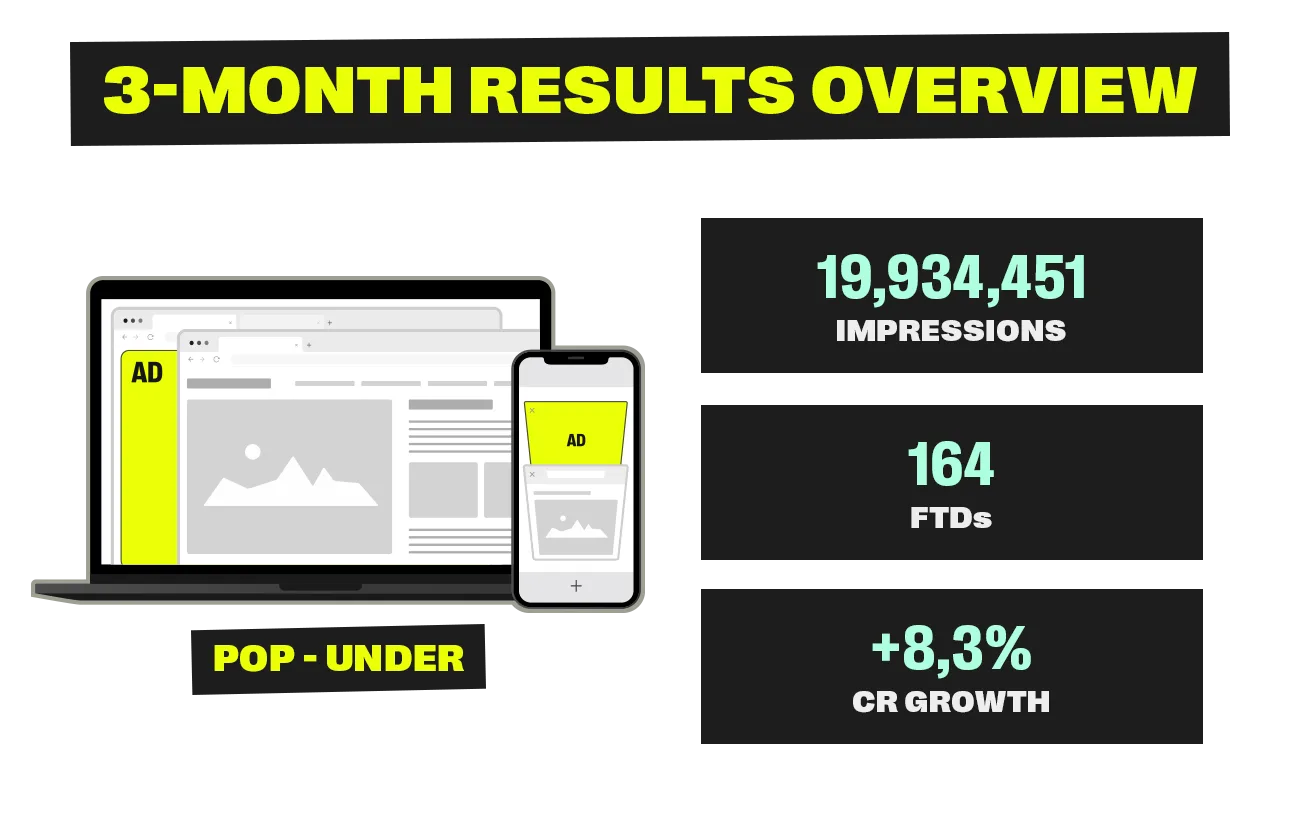
This case study breaks down a US-targeted online poker campaign that pushed nearly 20M impressions across three months on pop-under traffic. The campaign drove 496 sign-ups and 164 FTDs while pulling CPA from $289 down to $197 against a $250 target. You’ll see the Auto Rules setup, the placement-level bid logic, and how that consistency built the case for expanding into Canada and the UK.
Online poker is a crowded table. Dozens of brands, all chasing the same players, all promising the same thrill of sitting down at a real game. Our client had the product to back it up. What they needed was a way to spend smart in a market where every dollar gets matched against someone else’s bid.
That’s why our client needed an ace up their sleeve. A way to allow them to put their chips down when they were ahead, and to fold when the math wasn’t mathing. Auto Rules gave the campaign that read on the room. Real-time data, automated bid adjustments, and a system that didn’t blink when traffic patterns shifted overnight.
Quick context for anyone new to the platform: Auto Rules is the part of Adcash that watches your campaign around the clock. It shifts spend toward what’s working, automatically.
What Can You Do with Auto Rules in Adcash?
Auto Rules are automated, rule-based optimization tools inside Adcash that adjust bids and traffic allocation. If you want to learn about the product in more detail, check out the product overview in our Auto Rules launch blog.
The short version; for campaigns running at scale, Auto Rules removes the need for constant manual intervention. Performance stabilizes because the adjustments never stop.
What Makes Adcash’s Auto Rules So Effective?
Auto Rules solve the two biggest problems in campaign optimization: time and inconsistency.
Manual optimization is slow by default. You check performance, make adjustments, wait, and check again. Meanwhile, traffic keeps moving and budget keeps spending. Small delays compound into real inefficiency.
Auto Rules close that gap. Budget shifts toward high-performing placements automatically. Weaker traffic gets throttled before it burns spend. The system holds CPA targets without anyone having to babysit it.
Control doesn’t go anywhere. The strategy still comes from the advertiser. Auto Rules just make sure it gets applied the same way, on every placement, every time.
You get speed and consistency without giving up the wheel.
The advertiser had been running Auto Rules long enough that the optimization was already locked in. What we saw across these three months was the model proving itself at full stride.

Why Auto Rules Matter for Long-Term Scaling
A campaign performing well for a few weeks is not the same thing as a campaign performing well at scale. Volume changes the math. More placements means more variables. Manual optimization that worked at $500 a day starts breaking at $5,000.
Auto Rules keep the structure intact as the campaign grows. KPIs get enforced at every level, every day, regardless of how many placements are running. Costs stay under control because the system is watching all of them at once.
Campaign Breakdown
| Ad Format | Bid Type | Devices | OS Targeting | GEO Targeting | Vertical Targeting |
|---|---|---|---|---|---|
| Pop-Under | CPM | Desktop, Mac | Windows, macOS | The US | Sports, Entertainment, Adult |
The campaign is a US-focused online poker brand running pop-under traffic.
Auto Rules had been on the campaign well before the window we’re showing here, holding the line on two KPIs the advertiser had set from day one: $80 CPA for sign-ups and $250 CPA for first-time deposits.
Across January, February, and March, the campaign served just under 20 million impressions. That generated 496 sign-ups and 164 FTDs, a conversion ratio of roughly one in three sign-ups going on to deposit. Both KPIs ended the window comfortably under target. Sign-up CPA closed March at $65, well below the $80 ceiling. FTD CPA dropped from $289 in January to $197 in March, a 32% improvement that pulled it more than $50 under the $250 target.
By March the model was running clean enough that the advertiser opened up Canada and the UK. The US still carries around 90% of the volume, with the new GEOs scaling on the same Auto Rules setup.
Tactics and Strategy
The whole setup ran on KPI guardrails. If a placement drifted above target, bids dropped or traffic got throttled. If a placement stayed at or below target, bids went up to capture more of the volume.
Everything was handled at the placement level, which let the campaign isolate profitable traffic and scale it independently. Three publisher categories did most of the heavy lifting: Sports (video sites and channels), Arts and Entertainment (movie and TV publishers), and Adult. Auto Rules pushed budget toward those segments as the data confirmed they converted, while quietly throttling everything else.
Non-performing traffic was not cut outright. Bids were reduced gradually, letting weaker placements phase out on their own if they failed to convert. That avoided premature exclusions and kept the budget protected without the advertiser having to manually intervene every time a placement dipped.
The longer the rules ran, the more accurate they got. By March, the system was making bid decisions on a much richer dataset than it started with. This is part of why its performance pulled so far ahead of January.
Takeaways
Auto Rules pay off over time. Short-term, they save manual hours. Long-term, they hold KPI discipline as the campaign grows, which is when most setups start leaking.
Consistency is the real product. The advertiser’s strategy didn’t change month to month. What changed was that the strategy got applied the same way to every placement, every day, without anyone having to chase it.
GEO expansion came from data, not guesswork. Canada and the UK opened up because the US numbers gave the advertiser confidence the model would hold. Auto Rules made the US numbers reliable enough to act on.
Conclusion
Three months of stable performance. A 32% improvement on FTD CPA. A move into two new markets that wouldn’t have happened without the US numbers proving the model first. That’s what continuous optimization looks like when it’s running on the right system.
Auto Rules took the manual timing out of the equation and gave the campaign room to scale without watching the costs run away. If you want the same on your campaigns, start one with Adcash or reach out to support to talk through the setup.
Share
Learn more
Explore our resources and discover how to cultivate wisdom in an information-saturated world.



FAQ
What is an advertising network?
An ad network is like a matchmaker for digital advertising. It connects advertisers (that’s you) with websites (aka publishers) that want to sell ad space. Instead of negotiating with individual sites, you use an ad platform like Adcash to place your ads where they’ll hit the right audience – based on their demographics, interests, or online behavior. More reach, less hassle.
What types of ad formats are there?
There are five main types of ad formats.
Pop-up ads – These appear in a new window or overlay to grab attention and increase engagement.
Pop-under ads – Similar to pop-ups, but they load discreetly in the background, ensuring a non-intrusive user experience.
Interstitial ads – Full-screen ads that appear during content transitions (like between webpage loads or app screens) for maximum visibility.
In-page push ads – These look like traditional push notifications but appear directly on the webpage without requiring user opt-in.
Banner ads – Classic display ads embedded within the webpage, featuring images, text, or animations to drive clicks.
How Can Publishers Balance Revenue and User Experience?
Maximizing earnings shouldn’t mean annoying your visitors. The key? Smart ad placement and quality formats.
Use pop-under ads instead of intrusive pop-ups to keep the user journey smooth.
Limit interstitial ads to natural breakpoints in content flow.
Optimize push ads so they feel native rather than disruptive.
Work with a trusted ad network for publishers (like Adcash) that provides real-time optimization and non-intrusive ad delivery.
With the right balance, you can monetize your website without driving users away.
How do I advertise online?
Pick a solid advertising platform that connects you with top publishers (hint: Adcash). Whether you want pop-up ads, display banners, native ads, or video ads, we make it simple. Set your budget, target the right audience, and launch. Our adserver and programmatic advertising platform handle the heavy lifting – real-time analytics, smart ad optimization, and laser-focused targeting to maximize your ROI.