
Campaign Bidding Strategy for Beginners
Campaign bidding can look complicated when you’re just getting started, which is fair enough. Between CPC, CPM, and automated bidding, it can feel like every option comes with its own little trapdoor.
The good news: it’s not as hard as it looks once you understand what each bidding type is actually meant to do.
This guide breaks down the main bidding strategies available on Adcash, when to use them, and how to avoid the classic beginner mistake of choosing a bid type based on guesswork instead of campaign goals.
Start With the Right Setup
Your bidding strategy begins during campaign creation. Once you reach the Budget step, you’ll choose the bidding model that determines how your campaign competes for traffic and how your budget is spent.
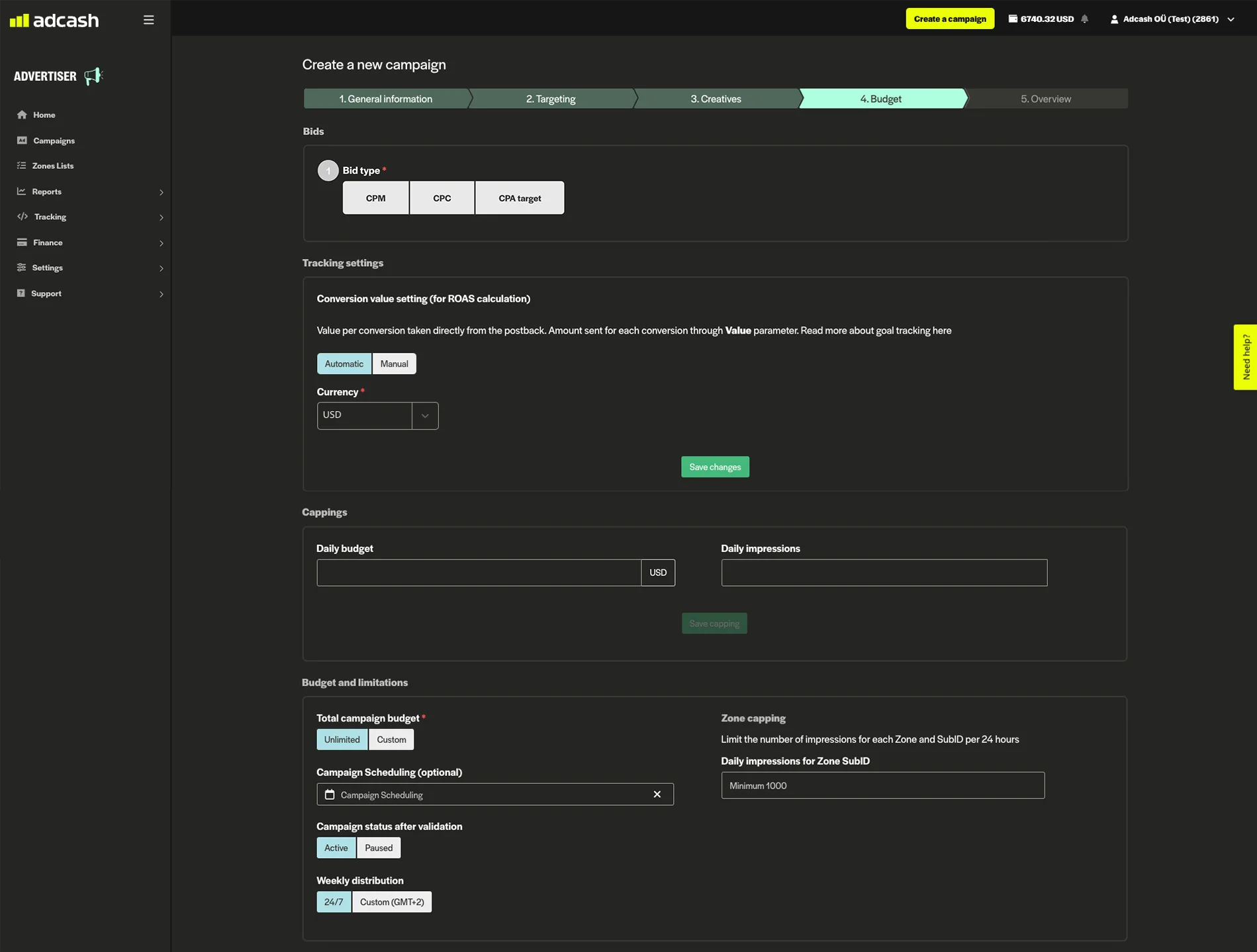
If your campaign is already live, you can review or adjust these settings anytime. Simply open your campaign from the Campaigns section and navigate to the Budget step. This is where you’ll select your bid type and define how aggressively your campaign competes in the auction.
Why Bid Type Matters
Your bid type shapes how your budget is spent, what traffic you can compete for, and how much control you have over performance.
Pick the right one, and your campaign has room to scale. Pick the wrong one, and you can end up paying too much, getting weak traffic, or starving the campaign before it has enough data to optimize.
There is no magic bid type that works for every advertiser. The right choice depends on what you want the campaign to do.
The Main Bidding Strategies
CPC Bidding Strategy
CPC stands for cost per click. With CPC bidding, you only pay when someone clicks your ad. That makes it one of the simplest options for beginners, because your spending is tied to a clear action.
CPC is a strong choice when:
- You want tighter cost control
- You are testing creatives or landing pages
- Your goal is to drive traffic instead of pure visibility
It can also be a good fit for advertisers who are still learning how different GEOs, devices, and formats behave. Another plus: you can set a maximum bid per click, which helps you stay in control of your budget.
With compatible ad formats (Display, In-Page Push, Interstitial, Video), CPC can also deliver strong ROAS (Return On Ad Spend) because you are paying for engaged users, not just impressions.
CPM Bidding Strategy
CPM stands for cost per mille, or cost per 1,000 impressions. With CPM bidding, you pay for visibility. That means your ad is shown to users, whether or not they click. You end up paying for how many impressions the ad receives.
CPM makes sense when:
- Your goal is a broad reach
- You want to build awareness
- You want more control over impression-based buying
It can also be a smart option if you already know your funnel works and want to buy traffic at scale. Because CPM focuses on impressions, frequency capping becomes important. You do not want to burn budget by showing the same ad too often to the same users.
CPA Target Automatic Bidding Strategy
With CPA Target (cost per acquisition), instead of manually adjusting bids, you set a target cost per acquisition, and the system automatically optimizes bids to help reach that goal.
This option is useful when:
- You’re still getting familiar with the bidding process
- You don’t want to be constantly adjusting bids
- Your main goal is to drive conversions
The system works in two phases:
Learning phase
During this stage, the algorithm collects data and analyzes traffic performance to identify the best opportunities for conversions.
Optimization phase
Once enough data has been gathered, the system focuses on the traffic sources most likely to deliver conversions while staying aligned with your CPA target.
Which Bidding Strategy Should Beginners Choose?
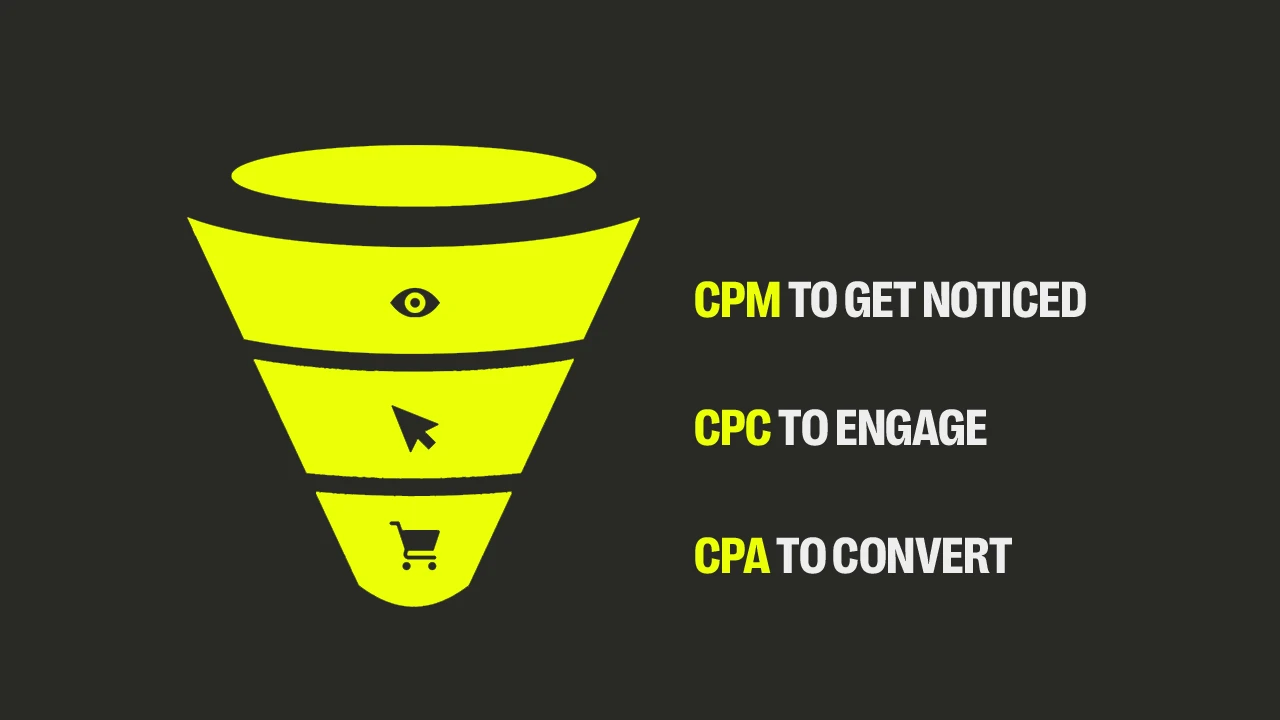
Here is the practical version:
- Choose CPM for reach and scale, in other words, to get noticed.
- Choose CPC for control and to chase engagement.
- Choose CPA Target if you want automation to do the heavy lifting, and you want to to convert.
If you are brand new, CPC is usually the easiest place to start.
If you already understand your funnel and want more scale, CPM can open up more opportunities.
If your tracking setup is solid and your goal is conversions, CPA Target can help you automate optimization.
A Quick Reality Check on Budget
Let’s be honest: bigger budgets usually make optimization easier. That doesn’t mean small-budget campaigns cannot work. They can. But larger budgets give campaigns more room to gather data, test traffic, and optimize faster.
In other words, a bigger budget does not guarantee success. It just gives you more breathing room and more signals to work with. If you are working with a smaller budget, patience is the name of the game. You can optimize the same as you could if you had a bit more cash, but it will take time to gather all the data you need. Don’t throw in the towel early!
Advanced CPM Strategy: 1 Bid vs 3 Bids per Country
Let’s say you choose CPM for your next campaign. You’ll then have to decide between:
- 1 bid per country
- 3 bids per country
This is where things get more strategic.
Why 3 Bids per Country Matters
To access Adcash’s quality tier bidding, you need to use CPM. With 3 bids per country, you can set different bids based on traffic quality tiers. That gives you more control over what you are competing for.
Here is the basic breakdown:
- Quality Tier 1: highest conversion potential, but lower traffic volume
- Quality Tier 2: solid balance of volume and conversion quality
- Quality Tier 3: highest traffic volume, but typically lower conversion rate
That does not mean Tier 3 is bad traffic. It means it serves a different purpose. If your strategy depends on scale and you know how to handle volume, Tier 3 can still be useful.
What Happens With 1 Bid Per Country
With 1 bid per country, you set one average bid, and that bid applies across the board. Sounds simpler. It is. But it is also less precise.
Here is the catch: if your single bid is too low for Tier 1, you automatically lose access to some of the stronger converting traffic. At the same time, that same bid may be too high for lower tiers, meaning you risk overpaying for traffic that does not need such an aggressive bid.
What This Actually Looks Like
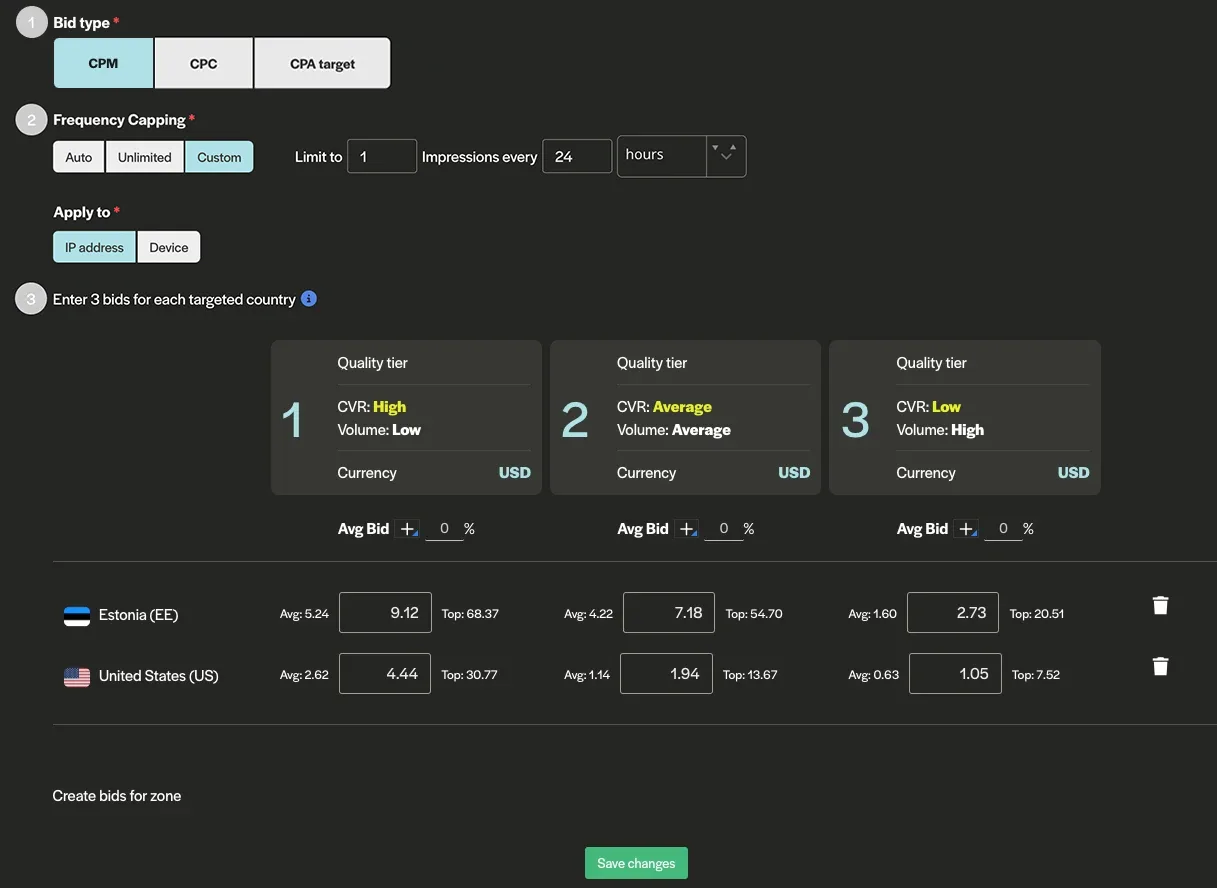
Let’s use the example above.
You’re running a CPM campaign targeting countries like Estonia and the United States, and you’ve chosen 3 bids per country. Here’s what’s happening in the interface:
Quality Tier 1 (High CVR, Low volume)
- Estonia average: $5.24
- Your bid: $9.12
This is premium traffic. Higher conversion potential, lower volume, and more competition. If you were using 1 bid per country, and your bid sat somewhere around $4–$5, you’d likely miss out on this tier completely. You simply wouldn’t be competitive enough.
Quality Tier 2 (Balanced)
- Estonia average: $4.22
- Your bid: $7.18
This is the middle ground. You’ve got solid volume and decent conversion rates. With 1 bid, you might land here. But here’s the catch: your single bid could end up being higher than needed, meaning you’re paying more than competitors for the same traffic.
Quality Tier 3 (Low CVR, High volume)
- Estonia average: $1.60
- Your bid: $2.73
This is volume traffic. Cheaper, less consistent conversions, but useful if your strategy can handle scale. Again, with 1 bid, you’d likely be overpaying here because your bid is being stretched across all tiers instead of tailored.
Why 3 Bids Usually Win
In most cases, 3 bids per country is the better option for CPM campaigns.
It lets you:
- compete properly for higher-quality traffic,
- stay efficient on lower-quality tiers,
- Avoid using one blunt bid for three different traffic conditions.
Put simply, it gives you more control and usually leads to smarter spending.
Conclusion
Bidding is not just a single step. It is part of your campaign strategy.
If you want simple control, start with CPC. For scale and visibility, go with CPM. Prefer automation focused on conversions? Use CPA Target.
If you are running CPM, do yourself a favor and seriously consider 3 bids per country over 1. One bid might look easier, but easier is not always smarter.
Start simple. Watch the data. Adjust based on performance. That is how beginners stop being beginners. If you need more help, reach out to the Adcash team.
Share
Learn more
Explore our resources and discover how to cultivate wisdom in an information-saturated world.