
How a LATAM Sports Publisher Earned $50K on Pop-Under
This case study looks at how one LATAM sports publisher transformed his earnings on Adcash. Across a few months, his site served just under 250 million impressions and earned over $50,000 in publisher revenue, with one peak month bringing in more than $11,000. The change came down to a shift in how he thought about his audience, plus two specific tools that did most of the heavy lifting: Frequency Capping and Anti-Adblock.
Sports traffic in LATAM is one of the most valuable audiences online right now. Fans are desperate for a reliable place to go. Get the experience right, and you’ll have truly loyal fans. On top of that, the constant stream of fixtures, across dozens of sports, takes care of most of the marketing on its own. The game is on, the stream works, and the site gets bookmarked for the next one.
It’s also one of the easiest audiences to ruin.
Our LATAM publisher learned that the hard way. He runs a sports website, and before he found Adcash, his approach to sports monetization was hurting him more than helping. He was working with other networks running pop-under, and everything about his setup looked right on paper, but his earnings were nowhere near what his traffic should have been pulling.
How Wrong Ad Networks Can Punish Traffic
When working with an ad network, the important thing to get right is the actual ads. I mean, it’s literally in the name of the service. Unfortunately, our publisher had an awful experience.
His site was ready. It ran like a dream. The ads were… a massive turn-off. They were super aggressive, and the quality was bad. Like, obvious-scam-level bad. Bad in other ways too. They slowed his page load times down way too much. Bounce rate went through the roof.
All of a sudden, his site wasn’t the clean experience he had worked so hard to build.
The result was a publisher actively paying to lose his own audience. Every user who landed on his site was getting hit with a worse experience than they’d get on a competitor’s stream. This network was supposed to be making him money. Instead, he was losing it. Traffic dropped. Earnings followed.
For sports sites, aggressive ad delivery, low-quality creative, and heavy ad scripts increase bounce rate and reduce session length, which directly cuts publisher earnings.
Adcash’s demand pool runs clean. Advertisers are vetted, the creative is reviewed before it serves, and the tech is built to load light. None of that is the kind of thing that gets put on a marketing banner, but it’s the foundation that makes everything else in this case study possible. Good, clean traffic on a good, clean site means growth is the next natural step.
The Results
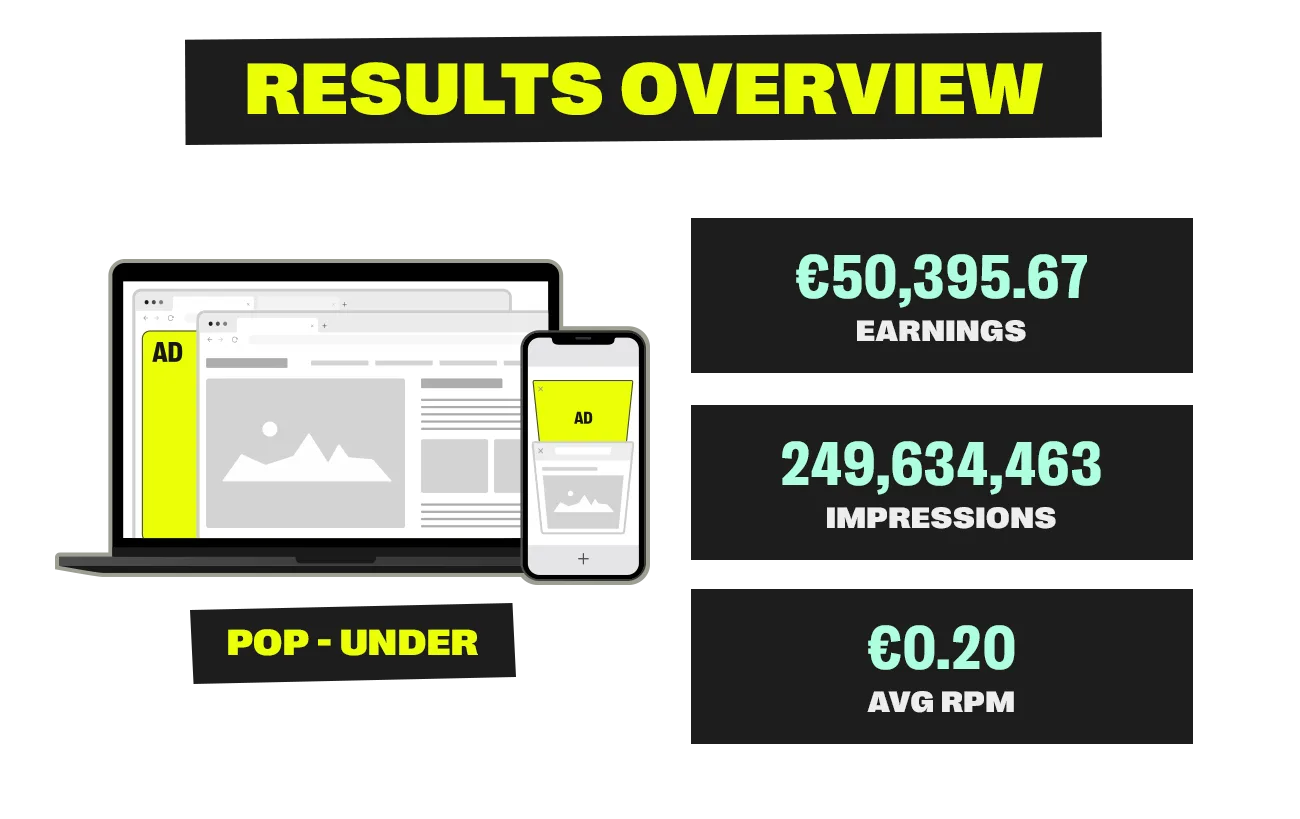
The mentality change shows up clearly in the numbers. In just 7 months using Adcash, the site served just under 250 million impressions. It earned over $50,000 in publisher revenue. Peak months even brought in five figures on their own.
| Month | Impressions | Earnings |
|---|---|---|
| Month 1 | 20,389,499 | $5,454.05 |
| Month 2 | 33,807,370 | $6,449.85 |
| Month 3 | 51,684,779 | $11,120.91 |
| Month 4 | 28,982,485 | $6,748.27 |
| Month 5 | 41,029,662 | $9,454.03 |
| Month 6 | 51,690,724 | $7,964.63 |
| Month 7 | 22,049,944 | $3,203.92 |
| Total | 249,634,463 | $50,395.67 |
The monthly view tells the broad story. Earnings climbed quickly after the switch, held at strong levels through the peak fixture months, and stayed healthy across the full period. The peak month alone brought in over $11,000 off 51 million impressions. This is the kind of return sports traffic is capable of when the setup is done properly. With the World Cup around the corner, that ceiling is about to get a lot higher.
| Week | Impressions | Earnings |
|---|---|---|
| Week 1 | 11,412,381 | $1,761.40 |
| Week 2 | 13,300,379 | $2,521.36 |
| Week 3 | 12,349,261 | $2,994.66 |
| Week 4 | 11,311,825 | $3,329.98 |
| Week 5 | 5,057,854 | $1,356.51 |
| Week 6 | 6,106,152 | $1,418.29 |
| Week 7 | 8,203,259 | $1,743.08 |
| Week 8 | 9,615,220 | $2,230.38 |
| Week 9 | 13,015,965 | $3,135.53 |
| Week 10 | 7,818,152 | $1,791.24 |
| Week 11 | 7,396,283 | $1,513.21 |
| Week 12 | 9,263,625 | $2,061.02 |
The weekly breakdown is where the consistency really shows. Revenue rarely dipped below the low thousands, and across the strongest stretches, the site was earning over $3,000 a week. This is what sustained sports monetization looks like when frequency is capped, and demand runs clean. Anti-Adblock was stepping in, recovering the revenue most publishers wouldn’t even notice they were losing.
How Frequency Capping Makes A Difference
When we asked him what move actually shifted the revenue, his answer was direct. Frequency Capping was the one that did it.
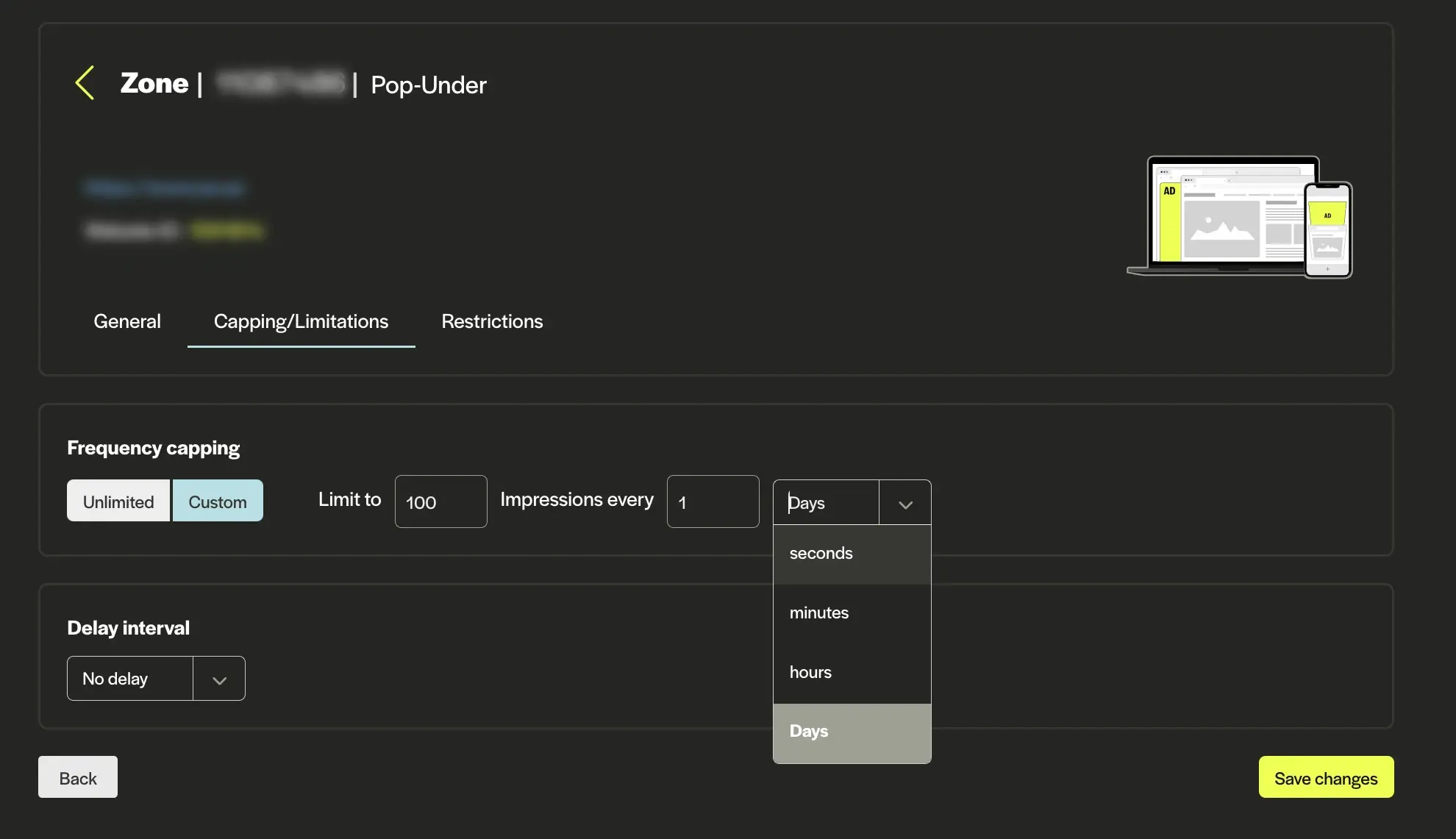
Frequency Capping is an ad delivery setting that limits how many times a single user is shown the same advertisement within a defined time period. Most publishers either ignore the setting or assume the network handles it for them.
Ultimately, it’s not logical for many publishers. By lowering ad frequency, surely you’re missing out on revenue. However, it’s the opposite, and the impact on sports monetization in particular is substantial.
Sports fans are repeat visitors by definition. They come back for the next match in the calendar, week after week. A network that hammers them with the same pop-under fifteen times in seven days is training them to stop coming back. The ad served on visit fifteen earns less than the ad served on visit one because the user is already irritated by then. Users who churn on visit five never see visits six through twenty at all.
He set sensible caps, and his earnings climbed. The total volume of ads served went down. Revenue per user went up. That’s the trade most publishers don’t realize is available to them.
Why Anti-Adblock Helps Build Revenue
When we asked what advice he’d pass on to other publishers in his position, his answer was Anti-Adblock. Too many publishers leave revenue on the table because they assume their numbers are the best they can get.
They’re not. Sports fans are particularly likely to be running ad blockers. They’re heavy media consumers, spending hours a week on sports sites. Most of them have a blocker installed as a default by the time they land on a new site. That means a meaningful chunk of any sports audience is generating zero revenue for the publisher hosting them. 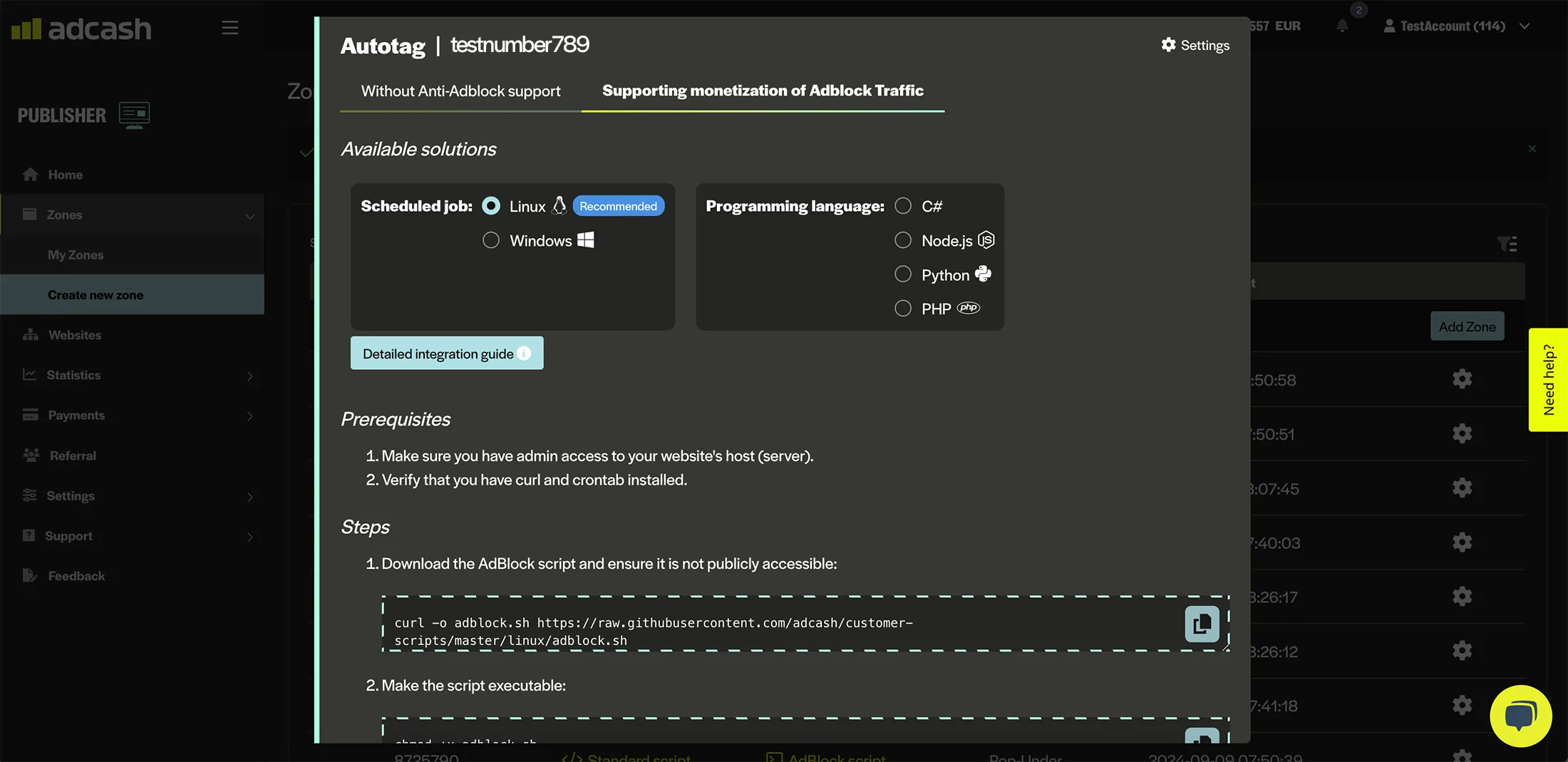
The most loyal segment, the users who would otherwise be the highest-earning cohort, is often the one most likely to be blocked. The Adcash Anti-Adblock solution sits in the dashboard and takes about thirty seconds to switch on. He flipped it on early, and the earnings followed.
Why It’s Important To Get The Right Fit
When publishers talk about why a partnership works, the word that usually comes up is “fit.” Vague, overused, but accurate. Sports traffic has a specific shape. We’re talking high volume, repeatable sessions, mostly on mobile. Equally important: the demand needs to match the geography it’s serving.
We built Adcash to handle that shape. The demand pool runs deep across LATAM, with advertisers actively looking for the kind of engaged, returning audience that sports content delivers. The pop-under format does its job without slowing the site down. The controls give publishers room to set their own rules on frequency, placement, and recovery. Everything they need for sports monetization is already in the platform from day 1.
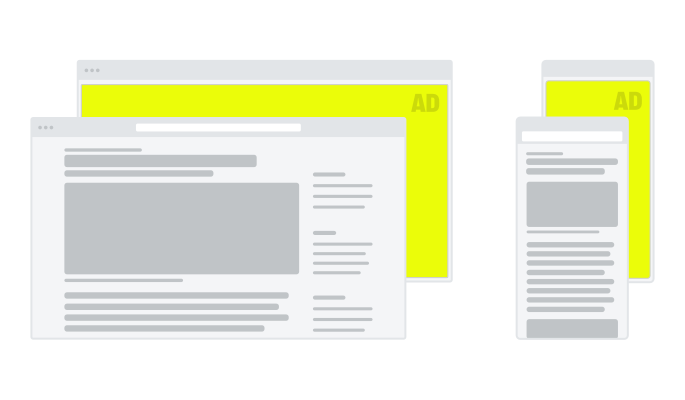
A good network doesn’t magic revenue out of thin air. It gives you the tools, the demand, and the runway to do the work yourself. Once he was on Adcash, the format he was already using started doing what it was supposed to do all along. For LATAM sports publishers, pop-under ads still earn the most. This works best with proper frequency capping and a working anti-adblock solution.
Conclusion
If you’re running a sports site in LATAM, the takeaway on sports monetization here is fairly straightforward.
Your traffic is super valuable. Fans are loyal, sessions are long, and intent is high. The calendar will keep delivering audiences whether or not you actively work to attract them. The harder part is making sure you don’t destroy that audience the moment they show up.
The publishers who win in this space are the ones who treat their audience like an asset. To monetize sports traffic effectively, publishers should pick an ad network with vetted demand, enable Frequency Capping to protect repeat users, and activate an Anti-Adblock solution to recover blocked impressions. Stop trying to squeeze an extra dollar out of a single user and let that user come back ten more times instead.
Our publisher figured this out. His site is now doing five-figure peak months, his earnings hold steady week after week, and his audience is still showing up.
Ready to do the same with your traffic? Sign up with Adcash and start monetizing your sports site the right way.
Share
Learn more
Explore our resources and discover how to cultivate wisdom in an information-saturated world.



FAQ
What is an advertising network?
An ad network is like a matchmaker for digital advertising. It connects advertisers (that’s you) with websites (aka publishers) that want to sell ad space. Instead of negotiating with individual sites, you use an ad platform like Adcash to place your ads where they’ll hit the right audience – based on their demographics, interests, or online behavior. More reach, less hassle.
What types of ad formats are there?
There are five main types of ad formats.
Pop-up ads – These appear in a new window or overlay to grab attention and increase engagement.
Pop-under ads – Similar to pop-ups, but they load discreetly in the background, ensuring a non-intrusive user experience.
Interstitial ads – Full-screen ads that appear during content transitions (like between webpage loads or app screens) for maximum visibility.
In-page push ads – These look like traditional push notifications but appear directly on the webpage without requiring user opt-in.
Banner ads – Classic display ads embedded within the webpage, featuring images, text, or animations to drive clicks.
How Can Publishers Balance Revenue and User Experience?
Maximizing earnings shouldn’t mean annoying your visitors. The key? Smart ad placement and quality formats.
Use pop-under ads instead of intrusive pop-ups to keep the user journey smooth.
Limit interstitial ads to natural breakpoints in content flow.
Optimize push ads so they feel native rather than disruptive.
Work with a trusted ad network for publishers (like Adcash) that provides real-time optimization and non-intrusive ad delivery.
With the right balance, you can monetize your website without driving users away.
How do I advertise online?
Pick a solid advertising platform that connects you with top publishers (hint: Adcash). Whether you want pop-up ads, display banners, native ads, or video ads, we make it simple. Set your budget, target the right audience, and launch. Our adserver and programmatic advertising platform handle the heavy lifting – real-time analytics, smart ad optimization, and laser-focused targeting to maximize your ROI.