From CPM to VAR - The World Cup 2026 Advertising Mega Guide
The FIFA World Cup 2026 is the biggest sporting event of the year. This also makes it the biggest advertising opportunity of the year. This guide breaks down exactly how to make the most of it. You’ll find the GEOs worth targeting, bidding strategies that convert during major tournaments, and a phase-by-phase playbook from the group stage through to the final. We cover the storylines and players driving traffic, and a dedicated publisher section on monetizing World Cup traffic. Whether you’re an advertiser planning campaigns or a publisher looking to maximize earnings during the tournament, this is your starting point.
Every four years, the world stops. Offices empty out, flags appear in windows that have never seen them before, and people who couldn’t name a single footballer suddenly have strong opinions about whether tikitaka is dead or not.
2026 is the biggest yet. 48 teams, three host countries, 104 matches, and a continent-wide tournament stretching from Mexico City to Toronto. New dark horses, new host cities, new storylines, and a whole lot of new eyes on screens. For advertisers and publishers, this is a once-in-four-years window. Miss it, and there’s nothing else like it for a long time.
Why This World Cup Is Different
The Biggest Ever
It kinda goes without saying what this means. More teams than ever means more games than ever. More games mean more opportunities and more exposure to campaigns and ads.
More teams mean more countries actively engaged and watching. For a lot of countries, this is their first-ever World Cup. Oh, hi Uzbekistan and Cape Verde (Jordan and Curcaçao too). You can be sure these countries won’t miss a second of the action.
A longer knockout stage means you have more eyes watching the games that matter. The group stage will get traction, for sure, but the knockout stage will increase the hype to another level. If it’s the biggest yet, then we can start rubbing our hands together.
More Than Just Football
Without going into detail, attention in North America this summer will be on more than just the football. For you, advertisers and publishers, this is actually a good thing. It means more than just sports verticals will benefit. News sites will also have plenty of opportunities to get in on the action, as well as the usual iGaming and eCommerce.
A Super Bowl-Style Halftime Moment
FIFA has just confirmed plans for an extended, Super Bowl-style halftime show at the MetLife final, a first for the tournament. For advertisers and publishers, this creates a scheduled attention spike sitting right inside the biggest match of the year. Super Bowl data tells us exactly what happens in moments like this: second-screen scrolling goes into overdrive, social feeds light up, and users actively discover brands during the pause.
The halftime show controls the TV conversation, but the web is just as active, often more so. Plan your creatives, bids, and publisher content around that window the same way you would game-day stoppages. Just like that, you’ve got a built-in conversion peak that didn’t exist at any previous World Cup.
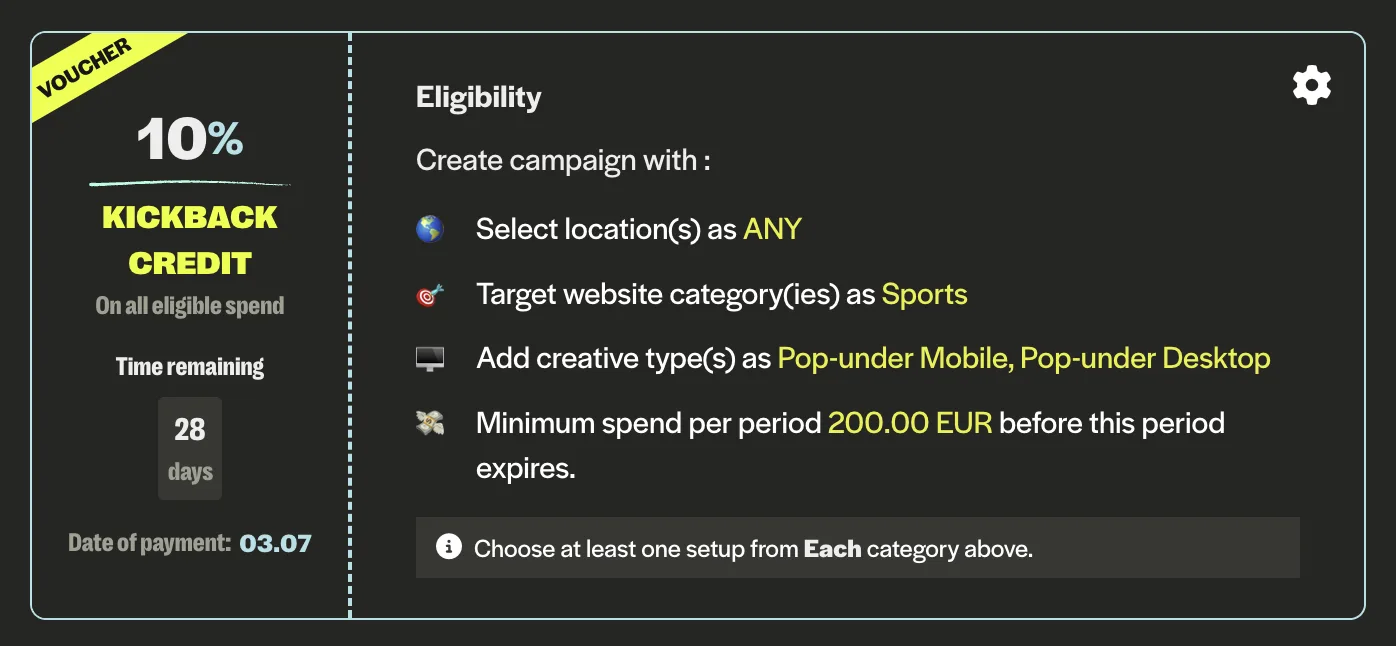
Here at Adcash, we’re getting prepped for the FIFA World Cup, and we hope you are too. We think the biggest sporting event in years deserves some extra hype, so we’re giving your campaigns a winning boost with a kickback voucher of 10%!
To be eligible, you must be running a sports campaign with pop-under (both mobile and desktop). Min-max spend must be between $200 and $50,000, meaning a potential return of $5000! For your 10% back, use code WORLDCUP26.
Countries to Target
We’ve got to be realistic about time zones. Games running in North America are going to be really difficult to watch live for half the world. Unless you’re a die-hard fan, Asia and Oceania miss out here.
Based on our internal data, here’s where you want to target:
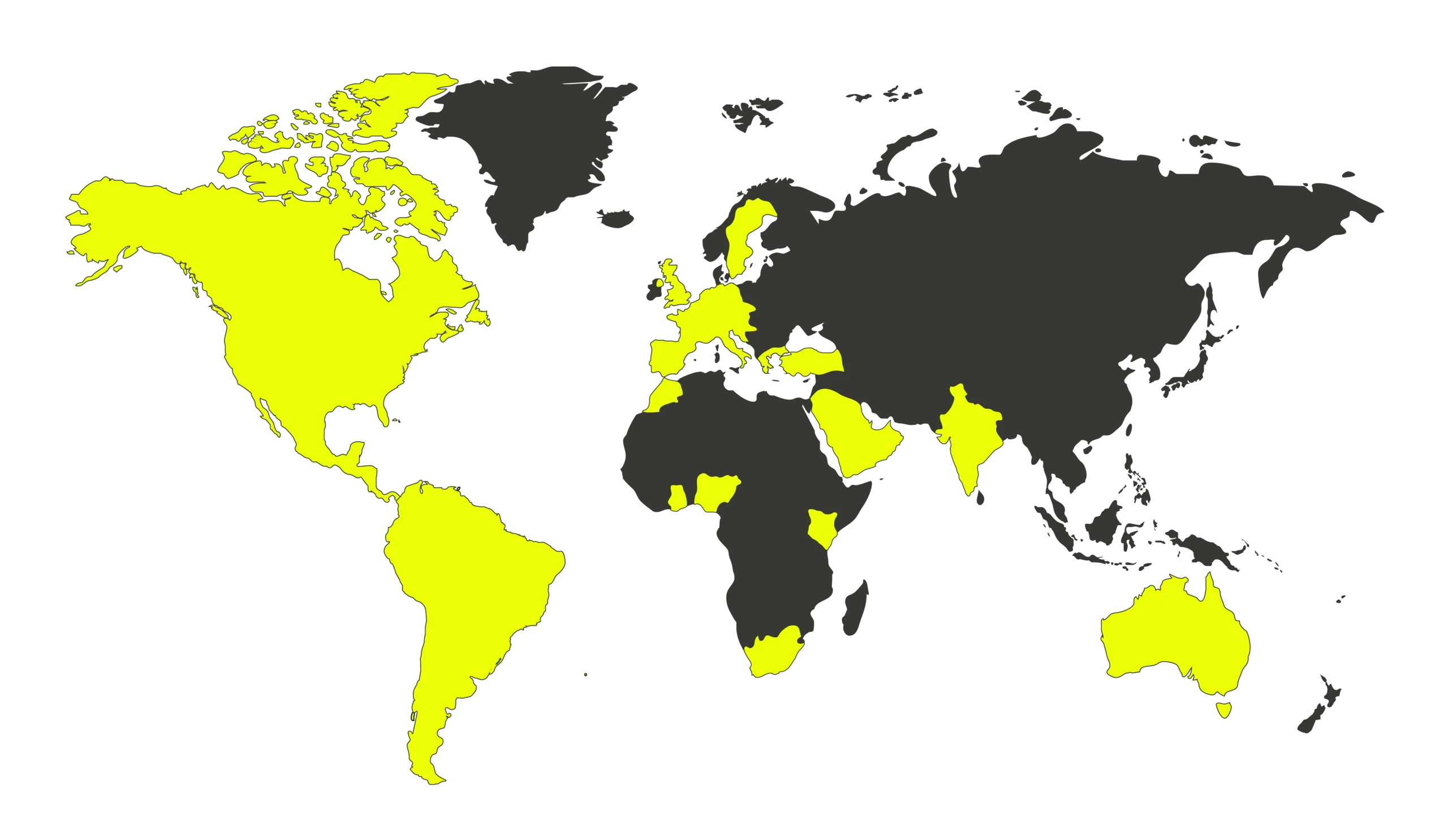
For South America, this tournament is a holiday in disguise. From Brazil to Colombia, they’re going to be lapping up as much action as possible. If they’re South American, and in the tournament, big focus on them. The time zones are perfect for those fans, too.
Obviously, we want a big focus on the US, Mexico, and Canada, too. It’s their backyard, their tournament – their attention.
Don’t ignore Africa. Expect huge traffic, especially from Nigeria, South Africa, Ghana, Kenya, and Morocco. For Europe, even though the time zones aren’t the best, don’t ignore them. Especially for countries like England, France, Spain, and Germany. They all believe they’re going to win, so you’d best believe they’ll be watching until the end.
When And How to Run Your Campaigns
Before we get into all the key match-ups and strategy, one thing is clear. If you want to win during the World Cup, start today. Campaigns need time to be optimized. Creatives need to be A/B tested.
For publishers, you need time to test as well. What ad placements work? How aggressive can your ads get before your audience clicks away?
The more confident you are in your strategy when the first ball is kicked on 11th June, the better your World Cup experience will be. But this is why we’re here. We can help you every step of the way. This isn’t our first international tournament after all.
Back to the fixtures. We’ve got 39 days of them. It’s a lot, and some days will get more views than others. But also, it’s a marathon, not a sprint. You don’t want your campaign to grow stale before the late knockout stages. So let’s help you break down what to focus on.
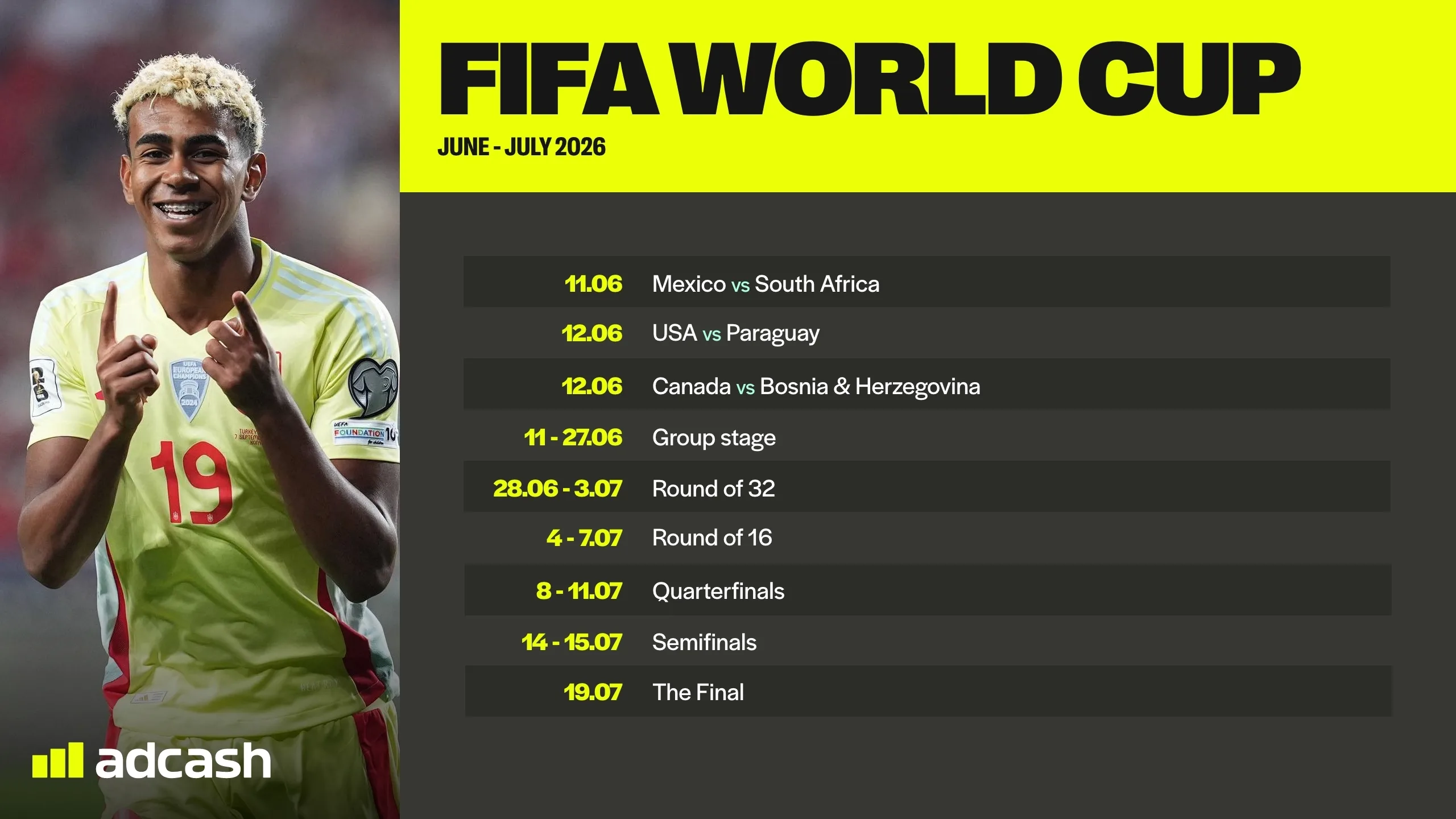
Here are the key fixtures to plan around (all dates CET):
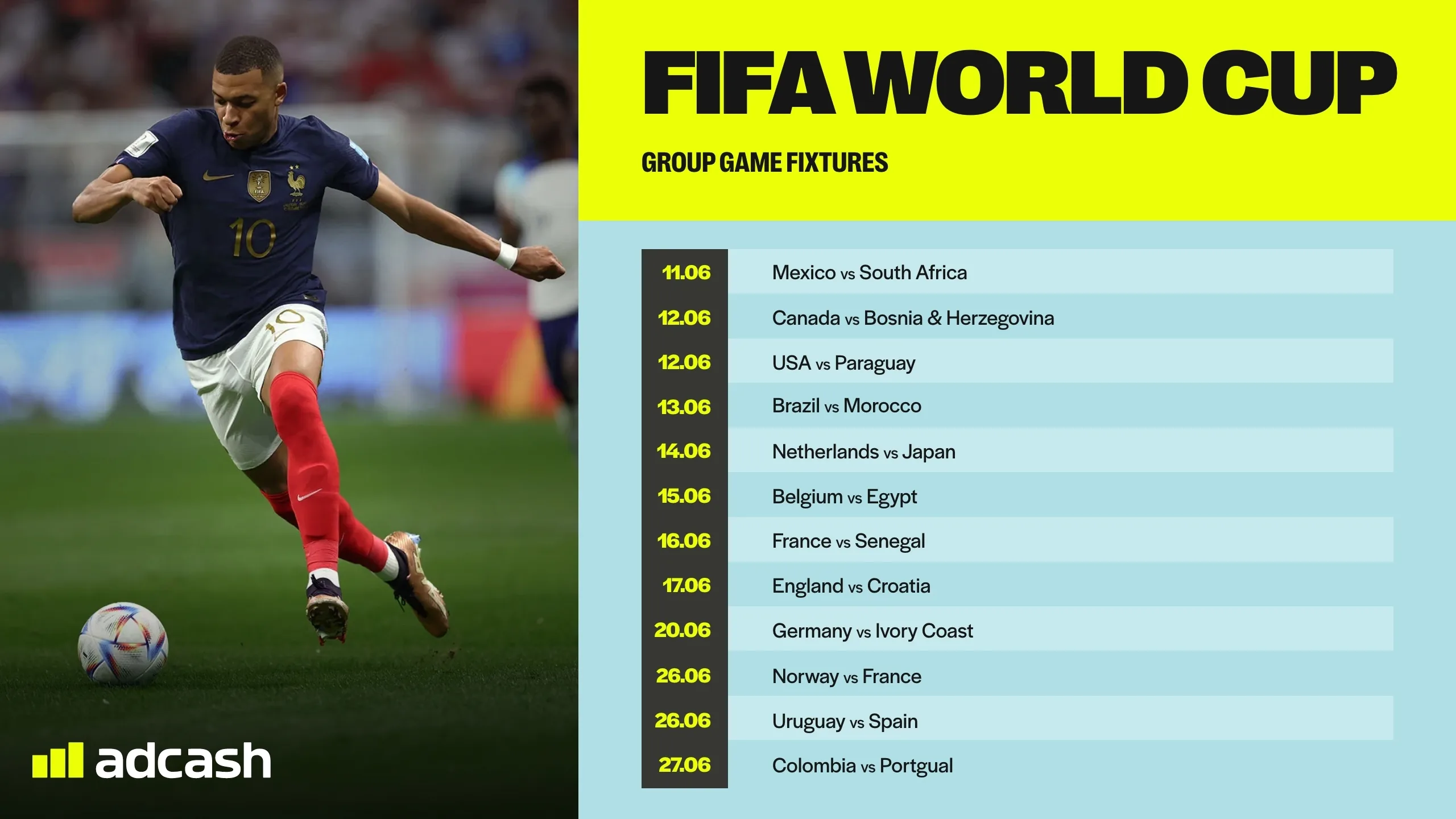
Timing matters as much as targeting
Like with all sports, you can’t set up your campaigns and walk away. Sport has surges of activity, followed by dips in attention. It’s important to know when to push, and when to pull back – no wasted budget around here! Here’s when to focus:
- 60–90 minutes before kick-off, as users hunt for previews, lineups, and odds
- During halftime. It’s time for those second screens to light up
- Immediately after the final whistle, especially after upsets or last-minute goals (and with the way VAR is going, there’s going to be a LOT of upsets)
Run your campaigns with an open budget during live matches. The biggest mistake we see during major tournaments is daily caps cutting off campaigns mid-spike. Don’t be the advertiser who tapped out at 75 minutes.
Live Match Strategy
This is where it’s won and lost.
- Push bids up in the 90 minutes before kick-off
- Stay flexible with budgets across the day. Group stage days often have three matches running back-to-back
- Double down on placements performing in real time
- Don’t sleep during off-hours. Highlights, recaps, and next-day analysis pull strong traffic with lighter competition.
For all the fixtures in detail, check out our Sports Calendar.
Who To Watch
Every World Cup has its favourites, its dreamers, and its wildcards. 2026 is no different. Except this time, there are 48 teams instead of 32, which means more chances for someone outside the usual suspects to crash the party.
For advertisers, this matters more than it might look. Traffic doesn’t just follow the trophy. It follows the storyline. Knowing which teams are pulling eyeballs in which GEOs lets you tailor creatives, ride momentum, and target audiences who are already invested.
The Favourites
Spain. The favourite for both the data models and bookies alike. If anyone arrives looking like the complete package, it’s La Roja.
France. Sitting near the top of every forecast that matters. Les Bleus have such great depth that they could probably send 2 teams to the semi-finals. Plus, star players for days.
Brazil. Five-time winners and never out of the conversation. Plus, the biggest fan base in the world, bar none.
England. “This is their year” for the 25th time. Fourth in the FIFA rankings, a stacked squad, and a fanbase that goes into overdrive at the first sign of momentum.
The Contenders
Argentina. Lionel Messi’s farewell tour, probably for real this time. Who isn’t going to want to watch?
Portugal. Always dangerous, always entertaining. A golden generation in transition, and CR7 pulls eyes regardless of form.
The Dark Horses
Morocco. The Atlas Lions stunned the world in 2022 by becoming the first African nation to reach a World Cup semifinal. North African and Middle Eastern traffic explodes when they play.
Norway. The popular dark horse pick. Massive talent, and a first World Cup appearance in 28 years. Novelty value combined with one of the most marketable players on the planet.
The Hosts
Worth a category of their own. The USA, Canada, and Mexico are all in the tournament automatically, and home advantage at a World Cup is a real, measurable force. Host nations consistently outperform their seeding. Even if none of the three lift the trophy, every match they play will be a domestic traffic event.
What this means for your creatives
The takeaway: don’t put all your campaign eggs in one basket. Build creative variants around at least three or four teams from different tiers. When Morocco knocks out Brazil in the Round of 16 (and someone will pull off something like that), you want creatives ready to ride the wave. Forget about a simple campaign still leaning on a team that’s already on the plane home.

Advertising Strategies
By now, you know when to spend and where the traffic lives. This is where the actual advertising campaign comes together. Formats, bids, creatives, and the verticals that turn World Cup attention into conversions.
Ad Formats That Work For Football
Football traffic is fast, mobile-heavy, and emotionally charged. Fans are scrolling between matches, refreshing for live scores, jumping between streams, and using second screens. Your formats need to keep up.
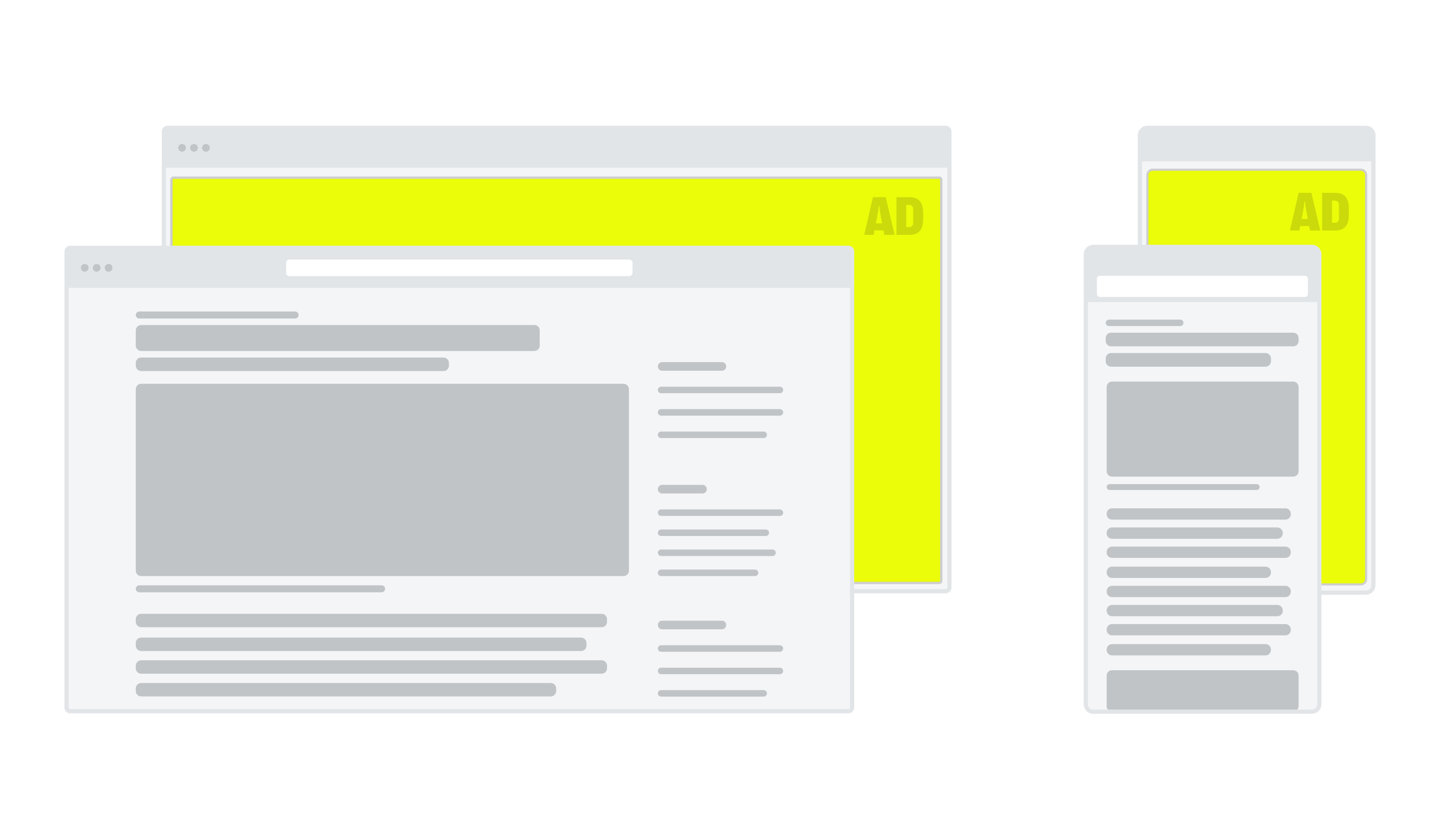
Pop-Under is the workhorse. High volume, non-intrusive, and built for audiences already engaged with something else on screen. During major football tournaments, publishers consistently report Pop-Under as their highest-RPM format, especially in tier-one markets. If you’re running just one format, run this one.
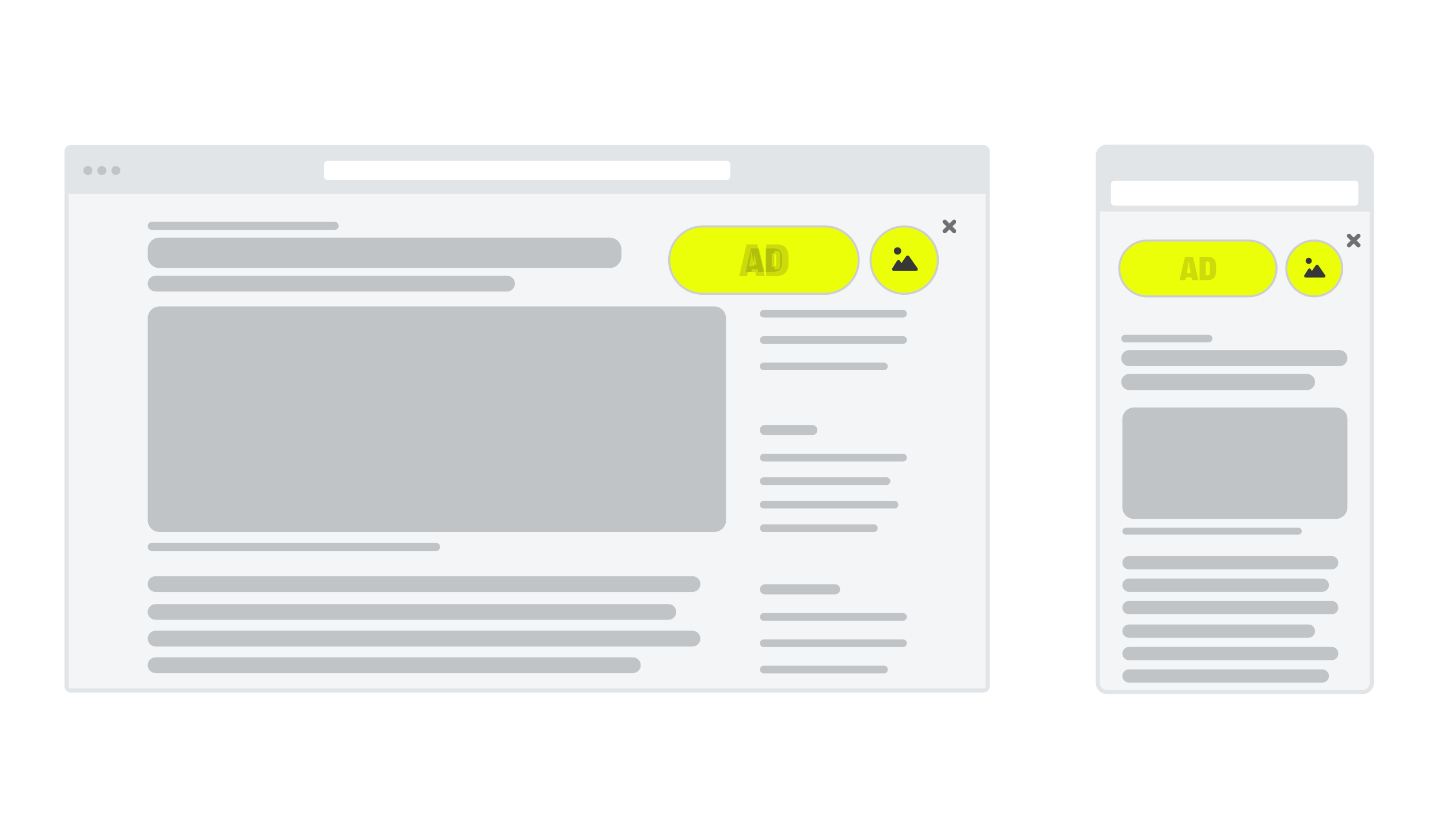
In-Page Push is the sharp end of the toolkit. It delivers instantly, reads like a notification, and works brilliantly for time-sensitive offers. Match starting in 30 minutes? Push it. Goal just gone in? Push it. Penalty shootout looming? You get the idea.
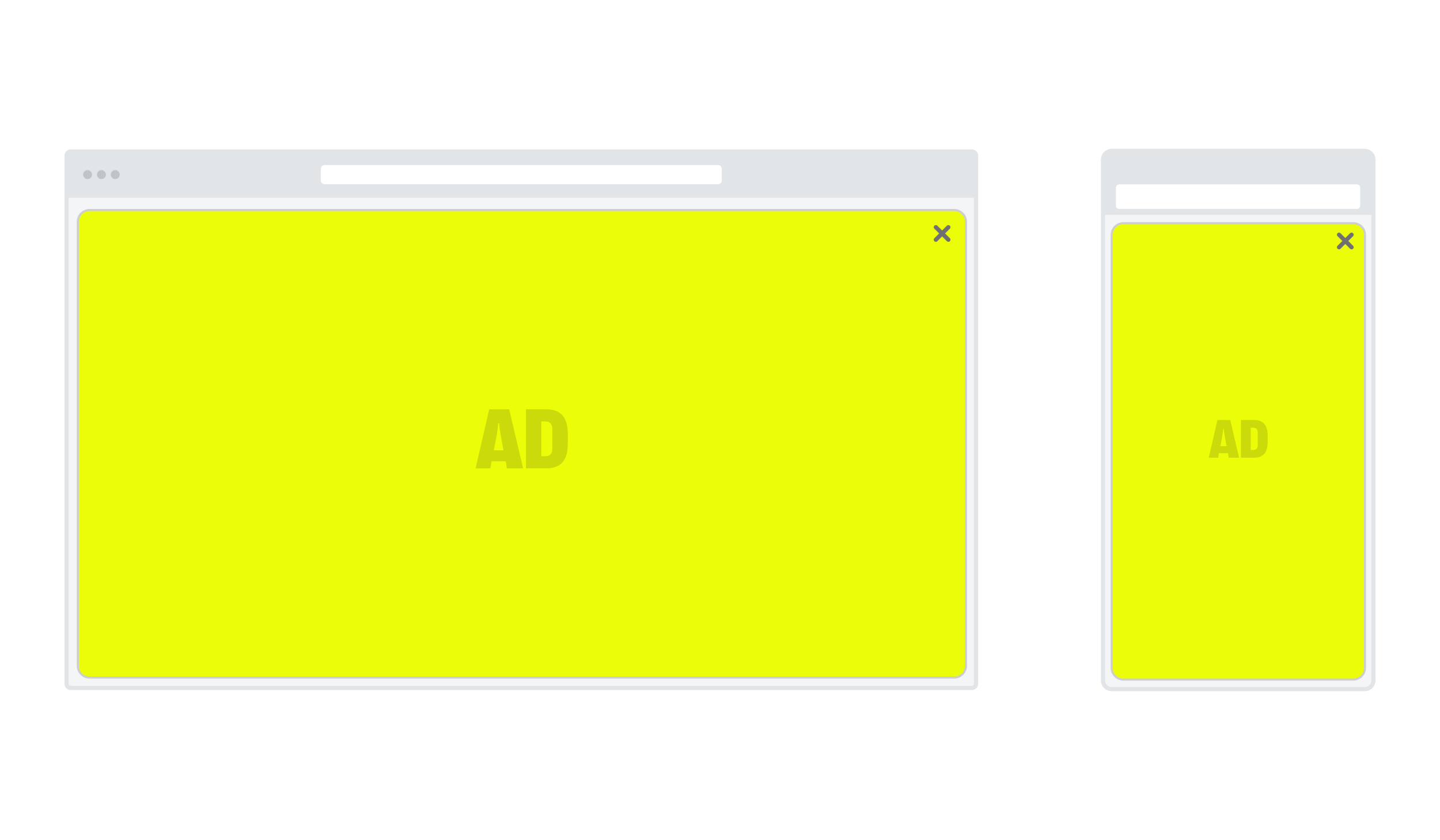
Interstitial ads slot in naturally at content breakpoints. Halftime is the obvious one, but think wider: between articles on a news site, between video segments on a highlights page, or between rounds of a fantasy app.
Bidding Models: Pick Your Game
CPA Target if you can track conversions. The system learns, optimises, and starts doing the heavy lifting for you, hunting down high-performing traffic and adjusting bids automatically. For betting operators, fantasy apps, and streaming sign-ups, this is the model to lean on.
CPM is the right call for Pop-Under campaigns where reach is the goal and conversion tracking is harder to set up.
CPC works best for Display, Interstitial, and Push formats where clicks signal real interest. You pay for engagement, not impressions.
One practical tip: don’t lock your bids in and walk away. Group stage bids and final week bids should look completely different. Push hard during matches that matter, scale back during dead time, and let your campaign breathe across the 39 days.
Creatives That Score
Your ads should look and feel like the tournament. Pitches, jerseys, flags, trophies, last-minute winners, scoreboards. This is not the moment for subtlety. Fans are hyped, scrolling fast, and primed to engage with anything that taps into that energy.
Three rules that pay off every tournament:
- Use team names and player references. A creative that says “Back England to go all the way” outperforms a generic “Bet on the World Cup” almost every single time. CTRs lift, conversions follow.
- Match your landing page to your ad. If the ad screams World Cup, the landing page needs to scream it back. Countdowns, fixture lists, matchday energy. Consistency converts.
- Build creative variants in advance. You don’t want to be designing a Morocco creative the morning after they knock out Brazil. Build a stable of variants now, ready to deploy when the storyline lands.
Verticals That Will Print
The World Cup is one of the few moments where almost every vertical has an angle. The big winners:
- Sports betting. The obvious one. Football is the most bet-on sport on the planet, and the World Cup is its peak.
- Streaming. Fans want to watch every match, so people will be turning up to do just that, wherever they are.
- eCommerce. Tournament merchandise is a multi-billion-dollar industry, and impulse buying peaks with the football.
- Fantasy and prediction apps. Bracket pools, fantasy leagues, prediction games. These convert hard during the group stage and pre-tournament build-up.
- News and media. This World Cup will drive serious traffic to news sites for everything beyond the football. There’s plenty to dig into here.
Test, tweak, repeat
The biggest mistake during major tournaments is treating campaigns as set-and-forget. The teams that win are the ones running A/B tests on creatives, watching placements in real time, and shifting budget toward what’s working hour by hour. 39 days is a long tournament. Use every one of them to optimise.
Warm up your campaigns before the World Cup kicks off! But manage those budgets well. Make sure you save enough to go all in on the biggest games later down the line!

Jimmy Dewerdt
Senior Advertiser Manager, Adcash
Publisher Playbook
If you’re a publisher, the World Cup is the opportunity. Sports traffic surges to levels you won’t see again for 4 years. Start planning now, and you’ll make monetization look easy.
Get your stack ready before kick-off
Advertisers aren’t the only ones who need to start now. Test your ad placements, format mix, and frequency settings in May, not June. By the time the opening match rolls around, your setup should be tuned and ready to handle traffic surges without dropping fill rates.
If you’ve been sitting on a single format, this is the tournament to diversify. Sports publishers who’ve cracked monetization consistently run a mix: Pop-Under as the revenue engine, In-Page Push for engagement, Interstitial at breakpoints. Each format earns where the others can’t reach.
Pop-Under is your best friend
We’ve seen it across every major football event we’ve worked with. Pop-Under delivers the highest eCPMs for sports content, especially in tier-one GEOs like the US, UK, and across Western Europe. It’s non-intrusive enough to keep your audience happy and high-volume enough to actually move the needle on revenue.
If you’re not running Pop-Under during the World Cup, you’re leaving money on the pitch.
Don’t fear frequency
A lot of publishers throttle ad frequency out of fear of losing readers. During a World Cup-sized event, that caution costs money. Switching to unlimited frequency capping and letting the system dynamically adjust exposure consistently delivers higher earnings without the bounce-rate disaster publishers worry about. Engagement stays strong because the traffic itself is high-intent. Fans aren’t there to casually browse. They’re there for the football.
GEO-specific setups
Not every market behaves the same. Your US traffic might convert beautifully on Pop-Under, while your Brazilian traffic prefers Push. Your UK audience will tolerate a different ad load than your Mexican one. Tailor your setup per GEO. Your account manager can pull location-specific data and help you adjust, which is exactly how the publishers running the highest RPMs do it.
Use World Cup Keywords
This is the easy win nobody bothers with. Team names, player names, match-ups, fixture dates. Put them in your URLs, headlines, meta descriptions, and on-page content. Search engines reward relevance, and World Cup-related search volume is about to go vertical. The publishers who rank for “England vs Spain live updates” the day before kick-off are the ones who collect.
Think Beyond July 19
The final whistle isn’t the end. The 48 hours after the final are massive for recap content, highlight reels, and “greatest tournament ever” debates. The week after delivers retrospectives, awards, and transfer rumours. Don’t switch off your monetization on July 20. The aftermath is real, and the advertiser competition spend drops sharply once everyone else has packed up.
Conclusion
The FIFA World Cup 2026 is the biggest advertising and monetization opportunity of the year. 48 teams, 104 matches, three host nations, and 39 days of guaranteed global attention.
The winning formula is simple: target the right GEOs (South America, North America, Western Europe), run the right formats (Pop-Under as your base, In-Page Push for live moments, Interstitial at breakpoints), pick the right bidding model (CPA Target if you can track, CPC and CPM where you can’t), and plan your campaigns around the tournament’s natural rhythm.
Start now. Test relentlessly. Build creative variants for multiple teams. And don’t switch off the moment the trophy is lifted.
Ready to play? Check out our Sports Calendar 2026 for every key date, and get in touch if you want our team in your corner for the tournament. And don’t forget to claim your 10% kickback using code WORLDCUP26 on all pop-under sports campaigns!
Share

Peter Howarth
Content Writer, Adcash
Good writing should feel like a conversation, not a lecture. I obsess over word choice so you don’t have to.