
The Rise of LATAM as a Global Digital Traffic Hub
Global advertising budgets are moving into Latin America (LATAM). LATAM traffic has become one of the fastest-growing in digital advertising, with global buyers drawn by large mobile-first audiences and strong engagement rates.
For years, Latin America was treated as a secondary market in global digital advertising. That position has changed. Major advertisers from North America, Europe, and Asia are now investing significant budgets in the region. Networks that once focused on Tier 1 markets are building LATAM-specific products. CPMs across the region are climbing.
LATAM has joined the ranks of markets that global buyers look for. Audiences are large and highly engaged, and pricing still works for performance campaigns.
Why Global Buyers Are Moving In
Tier 1 markets have become more expensive and more competitive over time. Cost per acquisition in the US and Western Europe has risen year on year, while audience attention has split across more platforms than ever.
Advertisers are looking to diversify their reach, and LATAM has become one of the regions delivering at the scale they need. The region has high engagement rates and long session times, with audiences that respond well to advertising placed and targeted properly.
This shift benefits everyone working in the regional market. Local publishers see better demand and higher payouts, while local advertisers gain access to better tools and more competitive pricing as the market matures.
The Markets Driving LATAM Traffic
Each major market in LATAM contributes something different to the regional picture.
Colombia
Colombia has become one of the most closely watched digital markets in Latin America. While it doesn’t match Brazil or Mexico in overall size, it continues to attract growing interest from advertisers, publishers, affiliate marketers, and ad tech companies.
As one of the world’s largest Spanish-speaking markets, it has both scale and cultural reach well beyond its borders. The country has also become a regular host for major industry events, including Affiliate World LATAM, eCommerce Day Colombia, Andicom, EXMA Colombia, and local IAB sessions.
Brazil
Brazil leads on size and ad spend. As the only Portuguese-speaking country in Latin America, it operates almost as its own ecosystem, with strong local platforms and a deep creator economy. The country has also become a major iGaming market since regulation opened the category to global operators, which has drawn significant international ad spend.
Mexico
Mexico combines scale with cross-border reach. Its proximity to the United States makes it a natural test market for global brands, which means local publishers and advertisers often see new products and ad formats first.
Argentina, Chile, and Peru
Each of these brings its own strengths. Argentina has a strong creative and tech sector. Chile has high digital spending per user. Peru continues to show some of the fastest growth rates in the region.
Smaller markets such as Ecuador, Uruguay, and the Dominican Republic add steady regional volume and are often part of wider LATAM media plans.
While each LATAM market has unique characteristics, the countries below are among the most important for advertisers and publishers looking to scale across the region.
| GEO | Key Strength |
|---|---|
| Brazil | Largest digital advertising market in LATAM with strong creator, e-commerce, and iGaming ecosystems |
| Mexico | Large audience reach and strong connections to North American markets |
| Colombia | Fast-growing digital economy, strong mobile adoption, and growing ad tech ecosystem |
| Chile | High digital spending per user and mature online consumer base |
| Peru | Rapid digital audience growth and increasing advertiser interest |
Why LATAM Traffic Performs
Audiences in the region are known for active engagement. Users comment, share, react, and click at rates that often beat Tier 1 averages. Session times tend to be long, and return visits are common.
This behaviour pays off across most major verticals. Dating sees strong, steady performance across all main markets. iGaming and sports betting have expanded rapidly, especially in Brazil, where regulation has opened the category to global operators. Fintech is one of the fastest-growing verticals, driven by digital banking and mobile wallet adoption. E-commerce, VOD, and online education round out the categories that consistently attract LATAM users.
Seasonal peaks tied to local culture also create reliable performance windows. Carnival, the Copa América, Día de Muertos, and the football calendar all drive measurable spikes in activity that buyers across the region plan around. A perfect example of this is the upcoming FIFA World Cup. Major sporting events like these are expected to drive significant increases in digital advertising activity across the region.
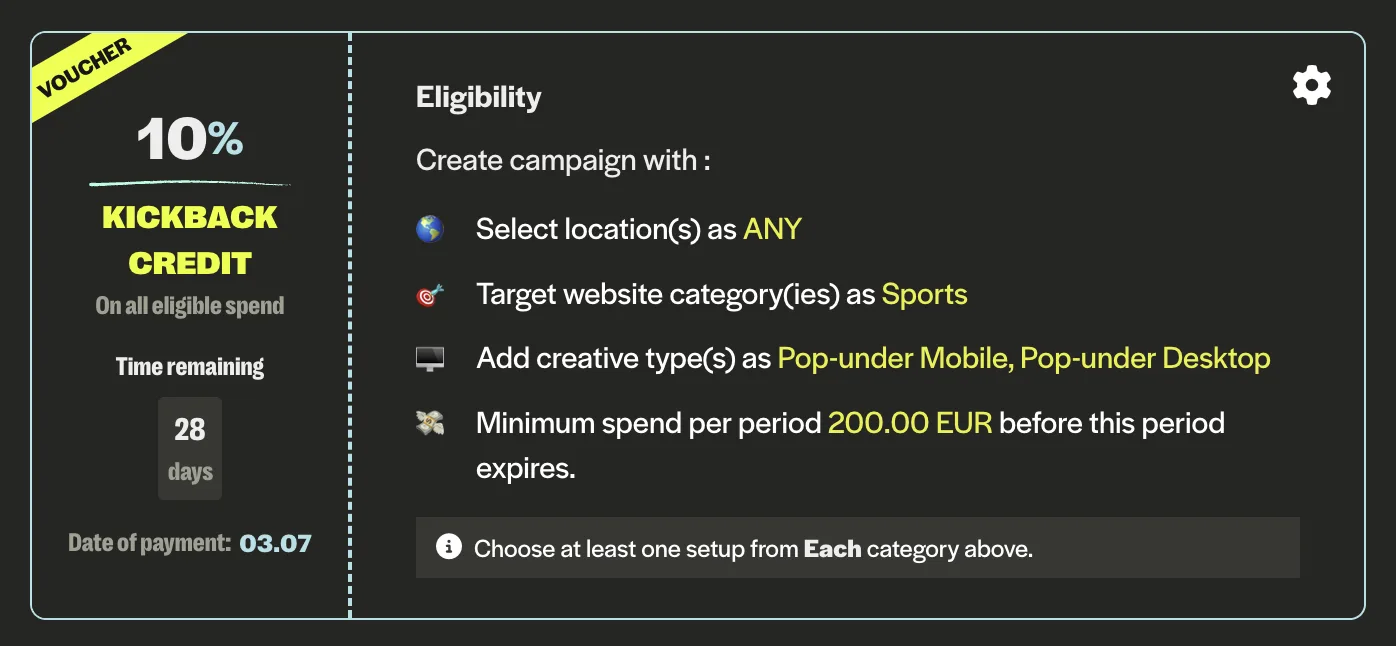
Here at Adcash, we’re getting prepped for the FIFA World Cup, and we hope you are too. We think the biggest sporting event in years deserves some extra hype, so we’re giving your campaigns a winning boost with a kickback voucher of 10%!
To be eligible, you must be running a sports campaign with pop-under (both mobile and desktop). Min-max spend must be between $200 and $50,000, meaning a potential return of $5000! For your 10% back, use code WORLDCUP26.
What This Means for Advertisers
For advertisers based in LATAM, the rising profile of the region brings real advantages. Better demand from international buyers means more sophisticated networks and stronger competition for ad placements, which keeps quality high.
Local advertisers also have a built-in edge over outside competitors. Outside brands often struggle with localisation and cultural fit. Advertisers who already understand the region can move faster and connect more naturally with their audiences.
The opportunity is to use that edge while the market is still growing. Costs are rising, but they remain attractive. The window to build audience and brand presence before international competition becomes heavier is open now.
What This Means for Publishers
For publishers, the change in how LATAM traffic is valued has been one of the most important shifts in the regional digital economy.
CPMs are rising, and fill rates from quality networks have improved. Advertisers are spending more on premium placements instead of treating the region as a cheap volume play. Global networks now use engagement metrics from LATAM sites to attract international buyers.
This puts regional publishers in a stronger position than at any point in the past decade. The traffic has always performed well, and the market is finally pricing it accordingly.
The publishers who tend to gain the most are those working with networks that understand the regional audience and pay on clear, consistent terms.
A Mobile-First Region
LATAM is one of the most mobile-first regions in the world. For many users, the phone is the only device they use to go online.
This shapes how campaigns perform and how inventory is priced. Creatives, landing pages, and ad formats built around the mobile experience tend to outperform those adapted from desktop. Networks that have invested in mobile-first formats, including in-page push, interstitial, and video, are well-positioned to serve the region’s audiences.
For advertisers and publishers working in LATAM, the mobile-first nature of the market is something both sides have built around. Global buyers also recognise it, which is part of why investment continues to flow into the region’s mobile inventory.
Conclusion
LATAM has moved from an emerging market to a core one in the global digital advertising mix. The region has valuable audiences and solid infrastructure, and its creators, platforms, and networks have built a digital economy that the rest of the world is now actively investing in.
For local advertisers, the moment is to scale while the market is in its growth phase. For local publishers, it is to capture the rising value of regional LATAM traffic. Both the buyers and the budgets are now in place, and the next phase belongs to the operators who already know the ground. If you’re looking for more proof, this case study shows exactly what LATAM traffic can achieve with the right strategy behind it.
FAQ
Which LATAM countries are leading digital advertising growth?
Brazil and Mexico remain the largest digital advertising markets in the region, while countries such as Colombia, Chile, and Peru continue to attract attention due to growing digital economies and increasing online engagement.
Why is Brazil important for advertisers?
Brazil is the largest digital advertising market in Latin America and the region’s only Portuguese-speaking country. Its size, creator economy, e-commerce sector, and growing betting and gaming industries make it a key market for many global advertisers.
How can publishers benefit from growing advertiser demand in LATAM?
As more advertisers invest in the region, publishers may benefit from increased competition for inventory, stronger fill rates, and improved monetization opportunities for quality traffic.
What advertising formats work best in LATAM?
Mobile-focused formats such as video ads, interstitial ads, in-page push notifications, and display ads often perform well due to the region’s mobile-first audience behavior.
Share

Peter Howarth
Content Writer, Adcash
Good writing should feel like a conversation, not a lecture. I obsess over word choice so you don’t have to.